Tuesday, October 18, 2016

Ivanka Trump: I’m Not Planning to Join Dad’s Administration - she said in interview - TIME

The energy on the 22nd floor of Trump Tower becomes a little giddier when Ivanka Trump enters the small offices that serve as headquarters for the Ivanka Trump collection. It's my third visit to the licensed apparel and accessories company since August, and Ivanka seems a little looser than she has appeared in recent TV interviews, laughing with her staff and double-checking her makeup and teeth before her photo shoot, gamely allowing our photographer to perch her all over the office in search of the best light.
As the initial excitement around her arrival subsides, the staff get back to work. I watch Ivanka as she follows my colleague’s instructions from behind the camera. A former model, Ivanka resets her face between shots, momentarily erasing her expression in preparation for her next pose. After the shoot, she calls out to one of her employees to fetch her coffee cup ("I really need it today!" she laughs—she just got back from picking up one of her kids from a short day at school), then resets herself again and sits across from me at a small white conference table, lowering her voice both in volume and pitch. Even her face becomes a little less expressive—not less pleasant, but a little harder to read.
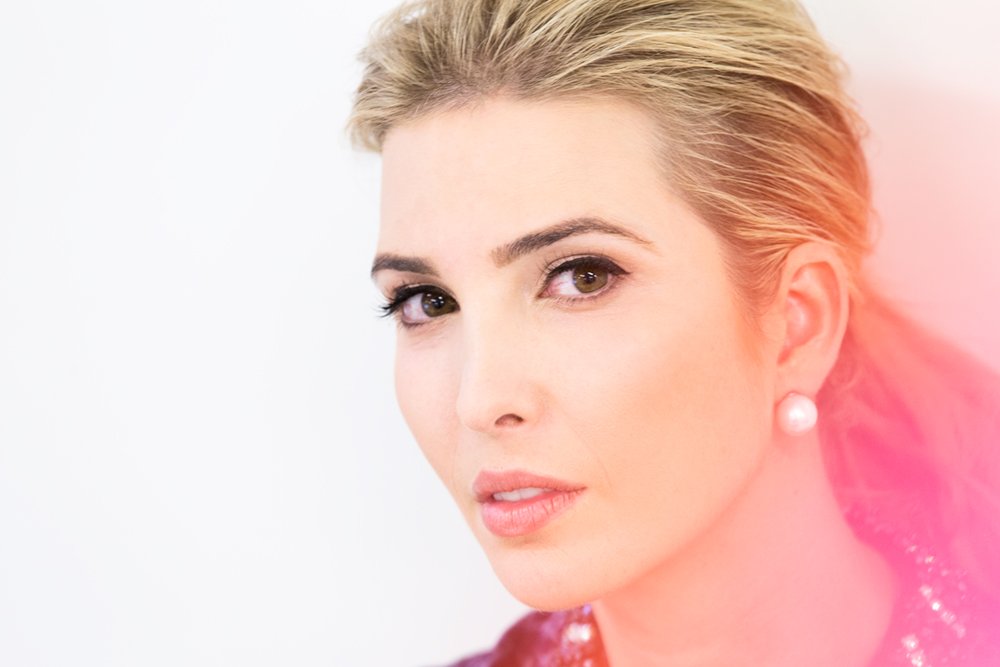
"I learned a long time ago that I can't control the opinions of others or what they project on me. All I can do is live my life, and I've tried to do that," she tells me a few minutes into our interview. It's a classic Ivanka statement, as if to say, I'm perfectly clear about who I am; it's not my fault what other people decide to think. It's easy to understand why she feels that way, and why Ivanka—always poised, always on message—seems to work so hard to keep her image under control.
Now 34, she has been in the limelight since she was a child, thanks in part to the soap opera of her wealthy parents' lives (her mother is former competitive skier and model Ivana Trump). And at the moment her father, Republican nominee Donald Trump, is running arguably the most controversial bid for the White House in American history. For the most part, she has managed to support her father's campaign, co-run The Trump Organization, and lead her own Ivanka Trump brand through the resulting noise. Her ability to engineer—and perhaps neutralize—her image is a skill that has served her well over the course of this year's presidential campaign, during which she has testified on behalf of her father, or at least stood sentry by him, numerous times.
"I mean, it's been a year and a half of enormous scrutiny, of my family, every business, every movement, action," Ivanka concedes. "But I think that, you know, that sort of comes with the territory. And I think I've probably learned a lot through it and I've probably grown a bit tougher in terms of my resilience toward what is our thrown our way because, you know, I've read some very negative stuff," she says, laughing a little, and sighing.
Sometimes the stuff that gets reported isn't just negative, I point out; it's actually shocking. For example, how does one wake up, read in the newspaper that your father is accused of sexually assaulting a minor, and continue to go about your day?
Ivanka doesn't flinch. "The greatest comfort I have is the fact that I know my father. Most of the people who write about him don't. I do," she says matter-of-factly. "So that gives me an ability to shrug off the things that I read about him that are wrong,"
But nothing compares to the uproar directed at Donald Trump this month.
First there was the leaked recording of Trump boasting about groping women, followed by a string of women coming forward to accuse him of sexual abuse. Public pressure on Ivanka has gone into overdrive.
Two weeks after our final interview, I reached out to Ivanka's publicist to get her reaction to the now-infamous 2005 recording of Donald Trump boasting about what amounted to sexual assault. "My father's comments were clearly inappropriate and offensive and I'm glad that he acknowledged this fact with an immediate apology to my family and the American people," Ivanka responded in a statement to Fast Company.
Rarely has Ivanka conceded any wrongdoing by her father. In the past, Ivanka has responded to sexism accusations against her father by calling him "an equal opportunity offender" who has "said plenty of rough things about men over the years." (Her father, for his part, blames the recent wave of accusations on a media conspiracy hell bent on keeping him out of the White House.)
Ivanka is not naive to sexism when she sees it; at one point in our conversation, when I mention that she has been referred to by the press as Trump's "surrogate wife," she cuts me off a little: "Which is deeply offensive. I feel that that's a very sexist thing to say." Meanwhile, the media continues to analyze her father's comments on her physique over the years.
"This has been a surreal experience for me," Ivanka says, straight-backed in her chair, long neck slightly bent toward me as she describes the year and half since she helped introduce her father's candidacy. Often, when Ivanka says something even remotely not-positive about the campaign, she adds a bright side to her statement: "And it's been an amazing one, and I've learned so much." Ivanka smiles when she speaks; she rarely breaks eye contact with me, unless there is some movement in the room—when I move my finger down my iPhone screen to scan my questions, I see her briefly glance at my hand before locking eyes with me again.
Many in the public—and the media—are obsessed with figuring her out, convinced that she secretly doesn't agree with her father's policies, eager for her to finally show her hand. "I mean, I think that Ivanka has a really thick skin," says Abigail Klem, head of brand at Ivanka Trump. "And one would have, if you've grown up in the public eye the way that she has."
Ivanka has built her business on a brand platform that champions working women, so why is calm, polite Ivanka supporting an unpredictable and combative candidate so many professional woman have accused of sexual harassment, they wonder? Is the root of her loyalty pure filial duty? Does she support him because he's rich (though how rich is anyone's guess?) Because she suffers from a form of Stockholm Syndrome? Because the exposure is good for her business? Because deep down, she's actually just like him? Because of her stated reason: that she truly believes he's the best man for the job? Those who question Ivanka's motives may as well stop holding their breath; this is a woman who, in her 20s, wrote an entire book loosely around the theme of holding one's "Trump" card close to one's chest until it's really needed.

BUSINESS AND POLITICS

One thing that's become clear is that the Ivanka Trump collection has benefitted from all the attention. Ivanka's appearances on the campaign trail, and in the audience at presidential debates, have doubled as free marketing. The Ivanka Trump collection dress she wore to the Republican National Convention quickly sold out, and working women's issues—the only area in which she has publicly gotten involved with the policies of her father's campaign—are core to her business's branding strategy. Her company caters to working women (and full-time moms) age 25 to 34 under the banner of the company's tagline "Women Who Work."
Net sales of just the clothing arm of the company were up $11.8 million during the first 6 months of 2016 compared to the first 6 months of 2015 as it sold its products online and at department stores, according to public filings from one of Ivanka Trump's major licensing and manufacturing partners. Forbesreported that Ivanka's clothing line generated $100 million in revenue last year, and sales were up $29.4 million from the previous fiscal year. The private company will not confirm specific sales figures, but do say their sales went up 37% last year, and that the growth rate has held pretty steady this year. And the website's traffic is up 50% over last year, thanks in large part to Ivanka's heightened public profile.
The flip side to the success has been a public dissection of her business and personal stance on issues like maternity leave and childcare anytime she stumps for her father. While publicizing Trump's maternity leave and childcare plans, Ivanka claimed his opponent, Hillary Clinton, hadn't come out with a plan of her own (she had). Ivanka also claimed that The Trump Organization offers all employees paid maternity leave (they don't). The 20-odd people who work full time for Ivanka Trump, however, do get eight weeks of paid maternity leave. At least one of Ivanka Trump's major licensing and manufacturing partners, G-III Apparel Group, doesn't offer its employees any paid maternity leave at all—but she tells me she doesn't have any plans to end Ivanka Trump Collection's relationship with G-III anytime soon.
"I don’t own that company, I don’t control that company," Ivanka says of G-III during our second interview, a phone call as she travels between campaign events in Colorado. "I do control my own business practices and that’s why I’ve chosen to offer an industry-leading eight weeks of paid leave, but obviously I can’t control the practices of everyone in the universe I do business with."
Her company is one of just 10% of American businesses that currently offer paid maternity leave. And while Ivanka doesn't offer childcare assistance to its staff (not that such a perk is common anywhere in America), several top-level Ivanka Trump employees with kids say the company is working parent friendly. Editorial director Sarah Warren was allowed to keep her job and work remotely from New Mexico after her husband was transferred to Albuquerque; head of brand Abigail Klem points to the company's flexible work schedule and vacation policy as crucial to her life as a single, working mom.
At least one former employee claims her experience at the company was very different. On Facebook, Marissa Velez Kraxberger, now vice president of creative at Rag & Bone, recently wrote about her experience as the chief marketing officer at Ivanka Trump, a position she left in 2015 after two years at the brand. Kraxberger, who did not respond to requests to comment for this story, claims that paid maternity leave was not originally Ivanka's idea at all. She writes: "when I recently saw a commercial with Ivanka and her father and their 'maternity leave' policy I felt like I was going to be ill. When I first interviewed with Ivanka I was two months pregnant, she called to offer me a job, which I was at the time very excited about, and when I asked about maternity leave she said she would have to think about it, that at Trump they don't offer maternity leave and that she went back to work just a week after having her first child. I somehow was dumb enough to accept the job after agreeing upon having the discussion further down the road about how we would handle the time after my baby was born. Our team—the ones who created #WomenWhoWork and the ones who the hashtag really stood for—fought long and hard to get her to finally agree to eight weeks paid maternity leave."
In a statement, an Ivanka Trump spokesperson told Jezebel that Kraxberger's version of events is a "mischaracterization of how our company developed its industry leading culture and benefits package."
A noteworthy part of Kraxberger's version of events is her claim that Ivanka said she had gone back to work just a week after her first child was born; it's notable because Ivanka is aware of the power of leading by example. In The Trump Card, the business memoir Ivanka wrote back in 2009, she expresses admiration for her friend Rupert Murdoch's habit of visiting the Wall Street Journal newsroom on Sundays (Murdoch owns the paper). Ivanka emulated the practice herself at The Trump Organization, writing "you'd be surprised by how quickly your employees will fall in line behind you when you set this kind of example."
I remind Ivanka that her own mother went back to work just two days after giving birth to Ivanka's elder brother, Donald Jr., and that Ivanka herself appeared on stage with journalist Gayle King just six weeks after giving birth to her third child. Since her father's childcare policy has been criticized for, among other things, not extending benefits to fathers or same-sex partners, I ask: Isn't paternity leave good for ambitious women? Trump responds that her father's plan isn't the final step, but a first step.
"Right now, under U.S. law, there is no paid leave," Ivanka points out. Donald Trump's plan, she says, "represents a very positive step in the right direction."
One thing Ivanka has been adamant about throughout this wild year is that "it's always been very important for me to separate business from politics"—and her staff echo this sentiment. In public and away from her company, for much of the election season, Ivanka has acted more like her father's character witness than a policy maker, though it has long been reported that she is one of her father's most trusted advisors on his campaign. Use the word "advisor" in front of Ivanka, however, and she will quickly correct you. "I am a daughter and an executive who has worked alongside him," she tells me.
But in the eyes of her potential customers, the line between presidential campaign values and Ivanka Trump values may seem more blurred than Ivanka and her employees will ever concede. The Ivanka Trump website is mostly dedicated to life and career advice, and readers are more likely to find an article filled with salary negotiation advice than a post about sexual harassment in the workplace. It has featured photographs of Ivanka wearingIvanka Trump-label clothing at Trump campaign events. And the "From Ivanka's Desk" section of the website featured her endorsement of her father's maternity and childcare platform which Trump himself has implied she helped influence. ("'Daddy, daddy, we have to do this,'" Trump said at an Iowa campaign event, caricaturing Ivanka. "She is the one that has been pushing so hard for it.")
"Our site traffic is through the roof, our emails...when you look at the numbers, you couldn't pay for this visibility," says editorial director Warren. The company's newsletter database is up 275% over last year, Warren reports. The site focuses on creating what Warren calls "short, snackable," and "actionable" content ("6 Tips for Talking to Your Kids About Money"; "7 Off Duty Habits That’ll Make You Smarter") and includes creative touches like print-out guides readers can take with them to, say, job interviews, which are actually pretty handy. This editorial-first approach—also favored by another celebrity-driven brand, Gwyneth Paltrow's Goop—does help set Ivanka Trump apart from other businesses that hawk work-appropriate clothing at working women, like Ann Taylor.

There are articles on the site featuring a range of thought leaders, ranging from MacArthur Grant recipients to startup founders. But some participants have expressed their discomfort at being featured on the site; Glossier CEO Emily Weiss recently tweeted regret over a Q&A published on IvankaTrump.com, writing "it's culled from an old interview; I wouldn't do it today." (Weiss did not respond to a request for comment on this story.)

The amazingly stable 2016 presidential race - NBC News

The amazingly stable 2016 presidential race
For all of its ups and downs, the primary results, the numerous debates and the bombshell stories, our latest national NBC/WSJ poll shows just how stable the Hillary Clinton-vs.-Donald Trump race has been over the past year. Just compare our poll's numbers three weeks before Election Day with the NBC/WSJ numbers from Jan. 2016, right before the Iowa and New Hampshire contests: 
  • Trump's fav/unfav rating in Jan. 2016: 29% positive, 58% negative
  • Trump's fav/unfav now: 29% positive, 62% negative
  • Clinton's fav/unfav in Jan. 2016: 40% positive, 49% negative
  • Clinton's fav/unfav now: 40% positive, 50% negative
  • The two-way ballot in Jan. 2016: Clinton 51%, Trump 41%
  • The two-way ballot now: Clinton 51%, Trump 41%
The more things have changed, the more they've stayed the same, right? One theory why the race has been so stable: By Jan. 2016, most Americans (and voters) had plenty of knowledge and information about both Clinton and Trump. Neither was an unknown figure, after all. 
Arizona vs. Colorado
But if you want to know where the presidential contest stands right now, look at today's activity in two states -- Arizona and Colorado. Today, Bernie Sanders campaigns for Clinton in Arizona, and First Lady Michelle Obama heads there on Thursday. Democrats haven't won the state in a presidential race since 1996, but are now making a clear play for it. By contrast, Trump today holds two events in Colorado, which George W. Bush carried in 2000 and 2004, but which Democrats look headed to win for a third-straight time. Indeed, a Quinnipiac poll released yesterday shows Clinton leading Trump by eight points in Colorado, 45 percent to 37 percent. Bottom line: You know the GOP is in trouble when it's facing an uphill climb to compete in Colorado, while Democrats are making a play in Arizona. 
Trump's dangerous (and false) rhetoric about vote rigging
Campaigning in Wisconsin yesterday, Donald Trump once again raised the specter of voter fraud affecting the election, NBC's Ali Vitali reports. "'People that have died 10 years ago are still voting,' Trump said. 'Illegal immigrants are voting.' While it is true that dead people are still on voter rolls, proof is scarce that this has caused widespread voter fraud. In fact, voter fraud is the opposite of what Trump dubbed it -- very unlikely. According to the Brennan Center's report on voter fraud, it's more likely that an American 'will be struck by lightning than that he will impersonate another voter at the polls.' Another study published in the Washington Post found 31 instances of voter fraud out of more than 1 billion votes cast from 2000 to 2014." What's more, top election officials in some key battleground states - like Colorado, Florida, Iowa, Nevada, and Ohio - are Republicans. And here's what Sen. Marco Rubio said at a Senate debate last night, per NBC's Alex Jaffe: "I promise you there is not a 67-county [in Florida] conspiracy to rig this election," he said, adding that Florida Gov. Rick Scott is a Republican and appoints those who run the elections. 
 Melania Trump dismisses 2005 tape as 'boys talk;' can she help Donald win female voters? 3:17
McCain suggests the GOP's Supreme Court blockade will continue
Remember when the Republican argument against considering President Obama's Supreme Court nominee Merrick Garland was because you shouldn't fill a SCOTUS vacancy in an election year? Well, the election year is almost over, but John McCain suggested in a radio interview that Republicans would be united against any Supreme Court pick Hillary Clinton makes next year, per CNN. "I promise you that we will be united against any Supreme Court nominee that Hillary Clinton, if she were president, would put up," he said. "I promise you. This is where we need the majority and Pat Toomey is probably as articulate and effective on the floor of the Senate as anyone I have encountered." A McCain spokeswoman later clarified McCain's comments to CNN. "Senator McCain believes you can only judge people by their record and Hillary Clinton has a clear record of supporting liberal judicial nominees," the spokeswoman said. "That being said, Senator McCain will, of course, thoroughly examine the record of any Supreme Court nominee put before the Senate and vote for or against that individual based on their qualifications as he has done throughout his career." 
First Read's downballot race of the day
With 21 days until Election Day, we'll be profiling key downballot races we'll be watching. Today's installment: the Illinois Senate race. The Land of Lincoln appears likely to deliver its Republican-held Senate seat back into the hands of Democrats. Republican incumbent Mark Kirk would have faced a difficult path in this blue state under any circumstances, but dealing with the lasting effects from his 2012 stroke and facing a strong Democratic opponent has made him the cycle's most vulnerable incumbent. Democratic Rep. Tammy Duckworth, a veteran who lost both legs during a tour in Iraq, has been a strong fundraiser and appears to have built a comfortable lead over the moderate Republican, who renounced his support for Donald Trump in June. 
Alert! 
Chuck Todd has launched a new podcast! In "1947: The Meet The Press Podcast," which will post weekly, he'll interview a single notable guest and go beyond politics. The first couple of episodes feature The New York Times' Maureen Dowd, astronaut Kate Rubins (who spoke to Chuck from the International Space Station), NY Mag's Andrew Sullivan, and The New York Times' Dean Baquet. Tune in! 
On the trail
Donald Trump, in Colorado, holds rallies in Colorado Springs at noon ET in and Grand Junction at 5:00 pm ET… Mike Pence campaigns in North Carolina… Tim Kaine hits Michigan… Bill Clinton is in Pennsylvania… And Bernie Sanders is in Arizona. 
Countdown to third presidential debate: 1 day 
Countdown to Election Day: 21 days 

Trump's denial of sex allegation is " rape myth and stereotypes 101 " specialists say - NBC News

Over the past week, as Donald Trump vociferously denied multiple allegations of the same uninvited sexual behavior he was caught on tape bragging about, advocates and survivors of sexual assault and harassment were listening. 
As with almost all things Trump, there was no subtext to his absolute denials, no carefully worded gloss or dog whistle, almost nothing to parse. Instead, Trump came out and said the nine women accusing him of groping or forcibly kissing them are ugly, crazy or lying. 
"People don't come forward because they're afraid they're going to be treated this exact same way," said Kate Harding, author of the recent book "Asking For It: The Alarming Rise of Rape Culture — And What We Can Do About It" and a survivor of rape. 
Harding said Trump is tapping into "rape myths and stereotypes 101." Among them, she said, is "the idea that rape or groping is a compliment, that it's something men can do because they can't control themselves." 
"People of all body types, of all looks, all backgrounds, are victims of this kind of sexual abuse and harassment," she said. "It is much more about the perpetrator's sense of entitlement and desire to assert his dominance than it is about what the victim looks" like. 
 Melania Trump: Husband Was 'Led On' in 2005 Tape 3:54
Shana L. Maier, a professor of criminal justice at Widener University in Chester, Pa., and author of "Rape, Victims, and Investigations", said she was "in shock" listening to Trump. 
"Sexual assault has nothing to do with sexual desirability whatsoever," she told NBC News. "Many people who are sexual predators are currently having consensual sex. The entire cause of rape and sexual assault is to have power over another person." 
Trump and several of his surrogates have also asked why these women have come forward now, in some cases — although not all — after decades of silence. 
Jessica Leeds, who told The New York Times that Trump groped her on an airplane in the early 1980s, has said she decided to end her silence because she heard Trump deny at the second presidential debate that he had ever actually done what he described to Billy Bush in 2005. 
"I just start kissing them. It's like a magnet," Trump said in the recently-unearthed recording. "Just kiss. I don't even wait. And when you're a star, they let you do it. You can do anything. Grab 'em by the pussy." 
The audio was recorded on an Access Hollywood bus tour in the presence of others. Access Hollywood is an NBC Universal program.

Chinese authorities warned Crown Casino last year about touting high roller gamblers - Bloomberg

Chinese authorities warned Crown Resorts Ltd. last year to halt its efforts to attract high rollers from the mainland to gamble overseas, according to a person familiar with the government’s move to detain 18 of the Melbourne-based company’s employees.
China confirmed on Monday that staff members of Crown Resorts were being held in Shanghai for alleged gambling-related crimes, a development that sent the company’s shares plunging. Crown Resorts was among companies that received warnings after China arrested employees last summer at Korea casino operators Paradise Co. and Grand Korea Leisure Co., according to the person, who asked not to be identified because the probe is confidential.
After the warning, Chinese authorities observed that Crown Resorts had senior executives make short business trips to China instead of spending long periods in the country, the person said. They also noted that the company shifted its marketing activities to focus more on resorts instead of casinos, the person said. Authorities don’t perceive those actions as amounting to a material change in Crown’s activities, the person added.

‘Deeply Concerned’

A spokeswoman for Crown Resorts in Melbourne declined to comment on any warning given to the company by Chinese authorities. Faxed questions to China’s ministry of public security, which oversees law enforcement activities, were not immediately answered.
China hasn’t specified any of the charges, and it hasn’t been possible to contact any of those detained. The detention and charges will not automatically lead to a prosecution.
In a rare public statement e-mailed by Crown on Tuesday, largest shareholder and Australian billionaire James Packer said he’s “deeply concerned” for employees held in China. The move wiped $1 billion from the company’s market value on Monday, with the shares falling 14 percent. They were up 1.7 percent in Sydney on Tuesday.
“Our number one priority is to be able to make contact and to ensure they are all safe,” Packer said. He also added he was “respectful” of China’s sovereign rules.

‘Break the Chain’

The action against Crown Resorts is part of a broader effort by Chinese authorities to curtail overseas gambling. The nation’s leaders have linked those activities to corruption, money-laundering and domestic instability, particularly because many Chinese gamblers who have gone broke were small business owners.
Police had been investigating Crown Resorts for several months as part of an operation targeting gambling-related activities dubbed "Duanlian" -- or "to break the chain" -- with the goal of terminating personal and financial links between foreign casino operators and Chinese clients, according to the person familiar with the case. The probe is focusing on whether the company enticed Chinese nationals to gamble in Australia, as well as if it used an illegal settlement network or other underground banking services to transfer money out of the country, the person said.
The operation risks reinforcing fears among international casino operators about doing business in mainland China, where it’s illegal to market gambling to Chinese nationals. It could also unsettle gambling businesses in Macau, the world’s largest casinos hub, which saw revenue decline in recent years as President Xi Jinping clamped down on corruption.

Gambling Raids

Macau has sought to diversify its economy since Xi in 2014 ordered the former Portugese colony to reduce its dependence on gambling. Casinos in countries including the Philippines, South Korea and Australia have sought to fill the gap by working with so-called junket operators who bring Chinese high rollers overseas and lend them money to gamble with -- in effect skirting the mainland’s currency controls.

In an operation this summer in the adjacent Guangdong province, Chinese police arrested nearly 800 people for crimes including "organizing illegal gambling activities overseas." Police also raided an underground bank linked to the crime group that turned up more than 20 billion yuan ($3 billion).
All of the employees from the Korean casino operators arrested in June 2015 have now been released. Six Paradise employees who were arrested have been set free after serving jail time, a company spokeswoman said Monday. Out of Grand Korea’s seven jailed employees, three were released in August and four on Monday, its spokesman said Tuesday.
— With assistance by Brendan Scott

Trump's son-in-law planning Trump TV after election - Financial Times

Donald Trump’s son-in-law Jared Kushner has informally approached one of the media industry’s top dealmakers about the prospect of setting up a Trump television network after the presidential election in November.

Mr Kushner — an increasingly influential figure in the billionaire’s presidential campaign — contacted Aryeh Bourkoff, the founder and chief executive of LionTree, a boutique investment bank, within the past couple of months, according to three people with knowledge of the matter.
Their conversation was brief and has not progressed since, the people said. Mr Bourkoff and Mr Kushner both declined to comment.
However, the approach suggests Mr Kushner and the Republican candidate himself are thinking about how to capitalise on the populist movement that has sprung up around their campaign in the event of an election defeat to Democrat Hillary Clinton next month. Mr Trump has in recent days ramped up his criticism of the “dishonest and distorted” mainstream media, which he accuses of being biased against him in collusion with the Clinton campaign. 
In an NBC News/Wall Street Journal opinion poll, published this weekend, Mr Trump trailed Mrs Clinton by 11 points nationally.
Mr Trump, whose campaign is headed by populist digital media entrepreneur Stephen Bannon, has denied that he wants to start his own channel. “I have no interest in a media company. False rumour,” he told the Washington Post last month, following a Vanity Fair report that he and his advisers had explored the idea.


Mr Bourkoff, who launched LionTree in 2012, has advised on transactions worth more than $300bn, including Liberty Global’s $23.3bn acquisition of Virgin Media and Verizon’s $4.4bn takeover of AOL. He is also John Malone’s favoured adviser and helped the so-called “Cable Cowboy” consolidate the US pay-TV industry — in deals that culminated in Charter Communications’ $78bn takeover of Time Warner Cable this year.
More importantly, Mr Bourkoff is a friend of Mr Kushner, who is married to Mr Trump’s daughter Ivanka. The two have worked together in the past: Mr Bourkoff advised Mr Kushner, who also owns the weekly New York Observer newspaper, when he tried to buy the Los Angeles Dodgers baseball team four years ago. 
Establishing a Trump television network would be difficult, even with a potentially large audience for its programming. 
Cable and satellite companies are loath to take on extra channels in an era of shrinking audiences and “cord-cutting” — the cancellation of pricey pay-TV subscriptions in favour of cheaper, online alternatives. An “over the top” digital service would be one possibility but still costly because Mr Trump and Mr Kushner would need to spend heavily on marketing, talent and technology.
Roger Ailes, the former head of Rupert Murdoch’s Fox News Channel, is a friend of Mr Trump’s but would be prohibited from working on a Trump television venture by the terms of his exit agreement with the news network. He parted company with Fox this summer following an independent investigation into claims he sexually harassed Gretchen Carlson, a former Fox News presenter. 
However, Sean Hannity, Mr Trump’s biggest cheerleader on Fox News, would be free to work for a prospective Trump network. Mr Hannity was among several Fox stars, including Bill O’Reilly, to have a clause in their contracts allowing them to leave if Mr Ailes did — although this clause will expire at some point in the near future. 
Talk about a Trump network has persisted, partly because of the fervent crowds that Mr Trump continues to attract on the campaign trail and his existing links to conservative media. Mr Bannon, the chairman of Breitbart, a network of rightwing news sites, was hired in August to run the Trump campaign. Breitbart is currently on a global expansion push, with the aim of adding sites in Germany and France to its existing operations in the US and Israel.