Monday, May 29, 2017

MI5 opens inquiries into missed warnings over Manchester terror threat - Guardian

MI5 opens inquiries into missed warnings over Manchester terror threat
Security service will explore whether it was guilty of failings, as raids take place in Moss Side and rising terror threat sparks political war of words.
Monday 29 May 2017 14.03 AEST
First published on Monday 29 May 2017 05.00 AEST
MI5 has launched two urgent inquiries into how it missed the danger posed by the Manchester bomber, Salman Abedi, amid claims his interest in being a potential terrorist killer was repeatedly reported to the authorities.
Britain’s domestic security service started one review last week, which will aim to quickly identify any glaring errors, while the other will be more in depth, the Guardian has learned.
On Sunday, the home secretary, Amber Rudd, refused to comment on whether opportunities were missed to spot the murderous intent of the 22-year-old before his deadly attack, as national security became the major issue in the general election campaign.
4274.jpg
How Manchester bomber Salman Abedi was radicalised by his links to Libya
Read more

The reviews come with security officials warning that the threat from Islamist terrorism keeps rising and is at an “unprecedented scale”, with other attack plots feared.
A 23-year-old man was arrested in the early hours of Monday in Shoreham-by-Sea, Sussex, on “suspicion of offences contrary to the terrorism act”, Greater Manchester police said, bringing to 14 the number in custody related to the Manchester attack inquiry. Police are also this morning searching a detached property in Whalley Range, south Manchester.
The fallout from the tragedy has triggered an intense war of words across the political spectrum, with Rudd claiming that there would be a greater risk of another atrocity if Jeremy Corbyn became prime minister.
As she accused the Labour leader of voting against anti-terror measures, with “no evidence he will keep people safe”, her Labour counterpart, Diane Abbott, hit back by claiming that government cuts, including to the police and border force, have “consequences”.
“Citizens have a right to expect that the government sets their safety and protection as their number one priority and provides the resources to achieve that. It is no exaggeration to say that this government has failed in that elementary duty,” the shadow home secretary told the Guardian.
Investigators believe Abedi, whose parents come from Libya, may have received terrorist training in the country, where some areas are believed to be a safe haven for jihadis. He returned to the UK from Libya just days before exploding a homemade bomb packed with metal bolts and screws, carried in a rucksack, murdering 22 people after the Ariana Grande concert at Manchester Arena on Monday 22 May.
Teachers and religious figures in Manchester who knew Abedi raised concerns about his extremist views on multiple occasions and over several years.
MI5 is believed to have conducted a quick review of the intelligence held about Abedi last week, but the inquiry was limited as the agency’s focus and resources were poured into the manhunt and recovering the materials linked to the bomb.
The second review will be more detailed and look at the decision-making around Abedi before his attack. A source said the key question, given what is now evident about the danger Abedi posed, would be: “Would different decisions be made?”
The longer review will look at the processes and systems used to assess suspects and what was known about any of the other main conspirators. The system of assessing and managing risk used by MI5 is coming under immense strain, given the service’s unrelenting and rising workload.
994.jpg
The race to find the Manchester terrorist network
Read more

Abedi had been examined by security service case officers in the past, but by last Monday was one of a pool of 20,000 one-time Islamist jihadi suspects. He was not one of the 3,000 people under active investigation.
MI5 says it has to prioritise which suspects it devotes its limited investigative resources to, to whom are deemed most dangerous. Rudd, speaking on the BBC1’s Andrew Marr Show on Sunday, said she did not want to “rush to conclusions” about intelligence failures. 
But she added: “We won’t shy away from looking at what we can do to keep people safe. We are in constant discussion with the security services and the police to make sure they have the right tools they need.”
Rudd warned that further members of Abedi’s network could still be at large. Speaking shortly before fresh raids were launched in Moss Side, Manchester, on Sunday afternoon, the home secretary warned: “We can’t be entirely sure that [the Manchester operation] is closed.”
A 25-year-old man was arrested on Sunday in the Old Trafford area of Manchester on suspicion of offences contrary to the Terrorism Act, bringing the total number of arrests linked to the attack to 14. A dozen of those remain in custody for questioning and two have been released without charge. Charges are expected against some.
In Brussels on Thursday, Theresa May confronted Donald Trump at a Nato meeting over the leak of detailed intelligence about the attack, which was shared across the Atlantic and published by the New York Times.

On Sunday, the president responded on social media, saying that May had been “very angry” about the leak.

Saturday, May 27, 2017

Trump's views on Paris climate accord is evolving - Bloomberg

Donald Trump’s views on the Paris climate accord are "evolving," according to his top economic adviser, who signaled the president may be willing to bow to pressure from European leaders and stay in the agreement if the U.S. wins assurances it can scale back its carbon-cutting commitment.
After German Chancellor Angela Merkel and other Group of Seven leaders pressed the U.S. to remain part of the pact of nearly 200 nations, Trump stressed his commitment to environmental protection.
“We made it clear that we want the U.S. to stick to its commitments,” Merkel told reporters after a closed-door G-7 meeting in Sicily on Friday. “There were very different arguments from us all urging the president to hold to the climate accord.” She said the discussion was conducted in a very “honest” atmosphere, leading to a “very intense exchange.”
Trump’s chief economic adviser, Gary Cohn said Trump "feels much more knowledgeable on the topic today," following exchanges with world leaders including some who "have been involved with the Paris agreement for many, many years."
Cohn stressed that Trump’s decision will ultimately be based on"what’s best for the United States." He cast the agreement as flexible enough to accommodate reductions in the U.S. commitment that would keep the deal from hindering the American economy.
The original U.S. pledge to pare emissions at least 26 percent by 2025 "would be constraining to our economic growth," Cohn told reporters. "But then you get into the whole discussion on Paris: Is it non-binding, is it not non-binding, can you change your levels, how easy is it to change your levels?"
After deriding climate change as a hoax and pledging to pull out of the Paris accord during his election campaign, Trump has sidestepped the issue and passed up a number of opportunities to outline his international stance on global warming. Top administration officials have deadlocked on whether the U.S. should uphold the pact.
In the meeting, G-7 leaders asked Trump his time frame for making a decision. Cohn said Trump told his foreign counterparts: "I’d rather take my time" and get to the right decision.
Donald Trump’s views on the Paris climate accord are "evolving," according to his top economic adviser, who signaled the president may be willing to bow to pressure from European leaders and stay in the agreement if the U.S. wins assurances it can scale back its carbon-cutting commitment.
After German Chancellor Angela Merkel and other Group of Seven leaders pressed the U.S. to remain part of the pact of nearly 200 nations, Trump stressed his commitment to environmental protection.
“We made it clear that we want the U.S. to stick to its commitments,” Merkel told reporters after a closed-door G-7 meeting in Sicily on Friday. “There were very different arguments from us all urging the president to hold to the climate accord.” She said the discussion was conducted in a very “honest” atmosphere, leading to a “very intense exchange.”
Donald Trump’s views on the Paris climate accord are "evolving," according to his top economic adviser, who signaled the president may be willing to bow to pressure from European leaders and stay in the agreement if the U.S. wins assurances it can scale back its carbon-cutting commitment.
After German Chancellor Angela Merkel and other Group of Seven leaders pressed the U.S. to remain part of the pact of nearly 200 nations, Trump stressed his commitment to environmental protection.
“We made it clear that we want the U.S. to stick to its commitments,” Merkel told reporters after a closed-door G-7 meeting in Sicily on Friday. “There were very different arguments from us all urging the president to hold to the climate accord.” She said the discussion was conducted in a very “honest” atmosphere, leading to a “very intense exchange.”
Trump’s chief economic adviser, Gary Cohn said Trump "feels much more knowledgeable on the topic today," following exchanges with world leaders including some who "have been involved with the Paris agreement for many, many years."
Cohn stressed that Trump’s decision will ultimately be based on"what’s best for the United States." He cast the agreement as flexible enough to accommodate reductions in the U.S. commitment that would keep the deal from hindering the American economy.
The original U.S. pledge to pare emissions at least 26 percent by 2025 "would be constraining to our economic growth," Cohn told reporters. "But then you get into the whole discussion on Paris: Is it non-binding, is it not non-binding, can you change your levels, how easy is it to change your levels?"
After deriding climate change as a hoax and pledging to pull out of the Paris accord during his election campaign, Trump has sidestepped the issue and passed up a number of opportunities to outline his international stance on global warming. Top administration officials have deadlocked on whether the U.S. should uphold the pact.
In the meeting, G-7 leaders asked Trump his time frame for making a decision. Cohn said Trump told his foreign counterparts: "I’d rather take my time" and get to the right decision.
But Trump told the other leaders that he still has reservations. China, India and other countries working to pare their climate emissions had seen job growth suffer -- and he made clear he was not prepared to live with that trade-off, Cohn said.
Trump told the leaders “he didn’t want to be in second place,” Cohn said, especially because he is committed to keeping his campaign promises to create jobs and improve working-and middle-class opportunities.
Merkel said that the U.S. made clear it hasn’t yet taken a decision on whether to scrap Paris “and won’t make a decision here” at the G-7.
Italian Prime Minister Paolo Gentiloni, the summit’s host, said separately that there was “no agreement” on the Paris accord.
“President Trump will take time to reflect on it, and the other countries are taking note of that,” Gentiloni said.
The Paris agreement may be addressed in a formal communique expected to be issued Saturday by the G-7, though the nations remained at odds Friday over possible wording that would draw unanimous support. 
Any language clarifying that member countries have the freedom to rewrite their pledges under the Paris accord could buttress those seeking to persuade Trump to remain in the pact. That has emerged as a key concern for Trump administration officials worried the U.S. is barred from staying in the accord while scaling back its carbon-cutting commitment.
Even without a formal decision on the Paris deal, Trump has moved to dismantle environmental policies seen critical for the U.S. to satisfy its pledge. For instance, the Trump administration started a review of fuel-economy standards for cars and light trucks, which along with other vehicles are the largest source of greenhouse gases in the U.S. And he set in motion a process to scrap a regulation forcing utilities to slash their carbon dioxide emissions.
Trump’s chief economic adviser, Gary Cohn said Trump "feels much more knowledgeable on the topic today," following exchanges with world leaders including some who "have been involved with the Paris agreement for many, many years."
Cohn stressed that Trump’s decision will ultimately be based on"what’s best for the United States." He cast the agreement as flexible enough to accommodate reductions in the U.S. commitment that would keep the deal from hindering the American economy.
The original U.S. pledge to pare emissions at least 26 percent by 2025 "would be constraining to our economic growth," Cohn told reporters. "But then you get into the whole discussion on Paris: Is it non-binding, is it not non-binding, can you change your levels, how easy is it to change your levels?"
After deriding climate change as a hoax and pledging to pull out of the Paris accord during his election campaign, Trump has sidestepped the issue and passed up a number of opportunities to outline his international stance on global warming. Top administration officials have deadlocked on whether the U.S. should uphold the pact.
In the meeting, G-7 leaders asked Trump his time frame for making a decision. Cohn said Trump told his foreign counterparts: "I’d rather take my time" and get to the right decision.
But Trump told the other leaders that he still has reservations. China, India and other countries working to pare their climate emissions had seen job growth suffer -- and he made clear he was not prepared to live with that trade-off, Cohn said.
Trump told the leaders “he didn’t want to be in second place,” Cohn said, especially because he is committed to keeping his campaign promises to create jobs and improve working-and middle-class opportunities.
Merkel said that the U.S. made clear it hasn’t yet taken a decision on whether to scrap Paris “and won’t make a decision here” at the G-7.
Italian Prime Minister Paolo Gentiloni, the summit’s host, said separately that there was “no agreement” on the Paris accord.
“President Trump will take time to reflect on it, and the other countries are taking note of that,” Gentiloni said.
The Paris agreement may be addressed in a formal communique expected to be issued Saturday by the G-7, though the nations remained at odds Friday over possible wording that would draw unanimous support. 
Any language clarifying that member countries have the freedom to rewrite their pledges under the Paris accord could buttress those seeking to persuade Trump to remain in the pact. That has emerged as a key concern for Trump administration officials worried the U.S. is barred from staying in the accord while scaling back its carbon-cutting commitment.

Even without a formal decision on the Paris deal, Trump has moved to dismantle environmental policies seen critical for the U.S. to satisfy its pledge. For instance, the Trump administration started a review of fuel-economy standards for cars and light trucks, which along with other vehicles are the largest source of greenhouse gases in the U.S. And he set in motion a process to scrap a regulation forcing utilities to slash their carbon dioxide emissions.

China is now getting its power from the largest floating solar farm on Earth - Independent

China is now getting its power from the largest floating solar farm on Earth
China is one of the most polluted countries in the world, according to the World Health Organisation.
Beijing in particular is known for its 'smog' or extreme pollution. 
Recently, China's been on a mission to turn this around and become a leader in renewable energy.
The Chinese Government has announced that they've completed the construction of the world's largest floating solar farm, and it's now producing energy. 
Sungrow Power Supply have created created a 40-megawatt solar power plant, which sits atop of a floodeed former coal-mining town in China's eastern Anhui province. 
A local government official said, 
The plant not only makes full use of this area, reducing the demand for lands – but also improves generation due to the cooling effects of the surface.

The Chinese government is committed  to increasing its use of non-fossil fuels by 20% and become a green superpower.

Friday, May 26, 2017

Donald Trump and NATO: Why His Silence on Article 5 Is a Big Deal - NBC News

NEWS TRUMP'S FIRST FOREIGN TRIP MAY 26 2017, 10:47 AM ET
Donald Trump and NATO: Why His Silence on Article 5 Is a Big Deal
by ALEXANDER SMITH
LONDON — President Donald Trump has often shocked and confounded the world with his unique brand of rhetoric. But on Thursday it was what he did not say that caused a stir.
The 45th president had been expected to promise that America would defend its NATO allies if they ever came under attack. That principle of collective defense is, in theory, cemented by Article 5 of the alliance's charter, NATO's core tenet. It means that "an attack against one ally is considered as an attack against all."
No other president since NATO was founded in 1949 has questioned that principle — until Trump.
He's called the alliance "obsolete" and has repeatedly urged its members to pay more toward bolstering their own militaries. Many of these nations do not currently meet NATO's recommended spending targets, and Trump has threatened that, unless they up their game, the U.S. might not back them up in a fight.
Asked in a New York Times interview last July whether he would protect smaller states from Russia, he said his support would be conditional on them paying up.
"If they fulfill their obligations to us, the answer is yes," he said.
““Once you start to undermine the alliance then the whole post-Cold War order breaks down””
As he has for many of his policies, Trump has given mixed messages on NATO. In April, he backtracked on the "obsolete" comment and called NATO a "bulwark of international peace and security."
But he has never explicitly endorsed Article 5.
Many commentators expected that to change Thursday when Trump gave a speech at NATO's headquarters in Brussels. After all, he was speaking alongside a mangled girder from the World Trade Center, a shrine whose very name was "The 9/11 and Article 5 Memorial."
The name refers to the attack on New York's twin towers, the only time Article 5 has actually been invoked. More than 1,000 military personnel from America's NATO allies have died in the subsequent U.S.-led war in Afghanistan.
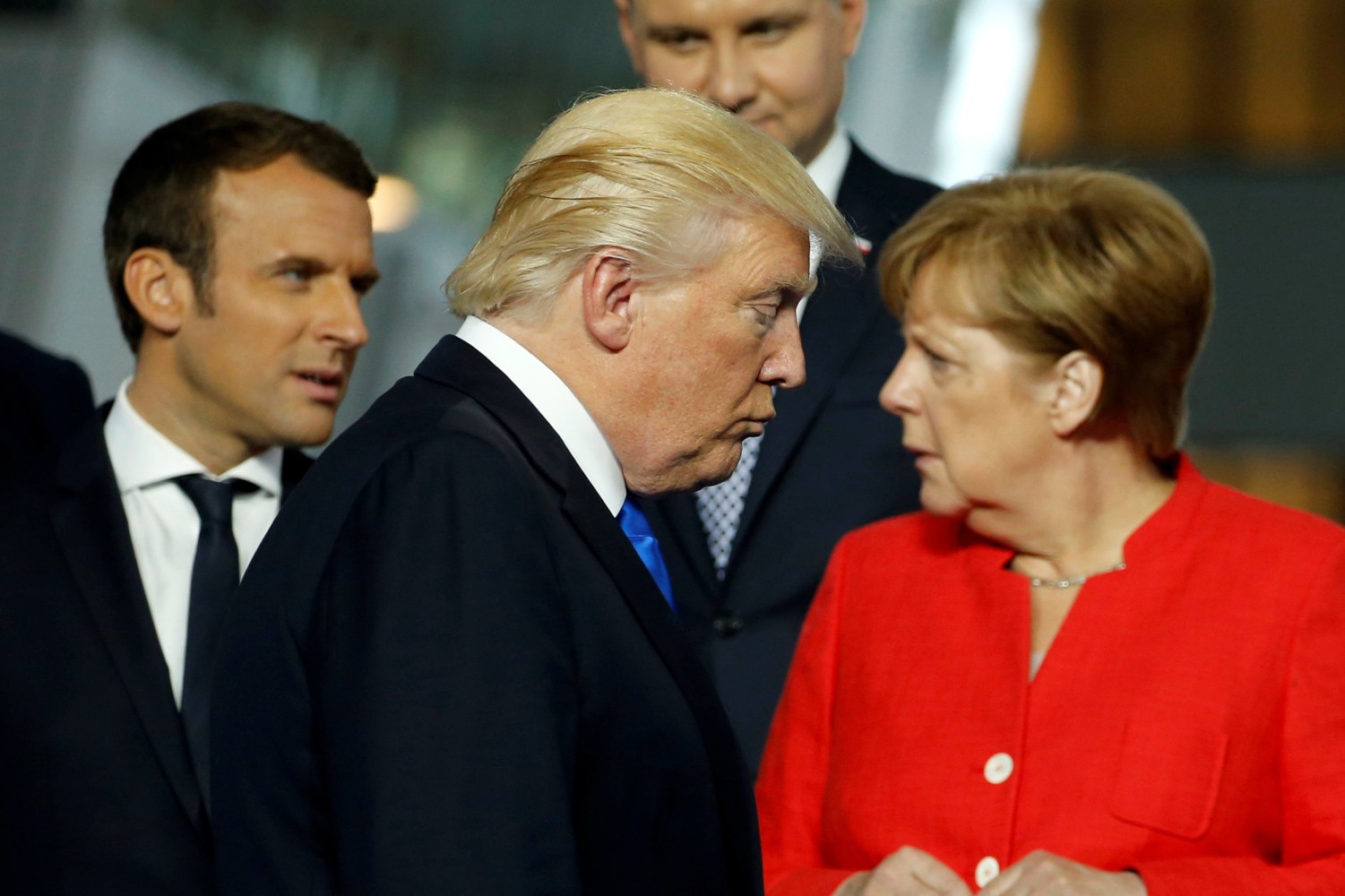
Image: President Donald Trump walks past French President Emmanuel Macron and German Chancellor Angela Merkel
172605-trump-g7-802a-rs_c20938a0fd6fa7cf4bd2c57797852f81.nbcnews-ux-320-320.jpg
President Donald Trump walks past French President Emmanuel Macron and German Chancellor Angela Merkel during the NATO summit in Brussels, Belgium, on Thursday. Jonathan Ernst / Reuters
Ahead of Thursday's speech, The New York Times quoted an administration official who was "briefed on the president's planned remarks" and said that Trump would make the promise.
But his speech stopped short of doing so.
Trump thanked other members for their support following 9/11 — "our NATO allies responded swiftly and decisively" — but was far from explicit on Article 5.
The president's spokesman, Sean Spicer, told reporters afterward that Trump's mere attendance was a tacit acknowledgement of his commitment to the mutual-defense clause.
"We all understand that by being part of NATO we have treaty obligations and commitments that we made as being part of NATO," Spicer said. "So to have to reaffirm something by the very nature of being here and speaking at a ceremony about it is almost laughable."
Many experts disagree.
Any sign that the U.S. might blink first could be taken as a signal by Russian President Vladimir Putin that cracks are appearing in NATO, according to many Western analysts.
"Article 5 is the whole point of NATO," said James Nixey, head of the Russia and Eurasia program at London's Chatham House think tank. "Articles 1, 2, 3, and 4 are all about talking. Article 5 is all about action — it's the only article that really means anything."
Although talk of all-out-war between America and Russia may seem remote, the possibility that Moscow may try to extend its influence in Eastern Europe had increased in recent years, according to many Kremlin-watchers.

GQGhc1cj_bigger.jpg
Putin will be thrilled at Trump's refusal to endorse Article 5. Unimaginable under any other president.
Some of the countries that are now in NATO were formerly part of the Soviet Union, a communist bloc controlled by Moscow whose disintegration Putin has called "a major geopolitical disaster of the century."
The Russian president enjoys sky-high domestic popularity — all built on his self-styled image as a man who can restore Russia to its former glory. He sees NATO as a Western encroachment on Russia's borders.
In March, NBC News traveled to Latvia, one of the former Soviet countries now in NATO.
Some people living there, around 20 miles from the Russian border, said they felt Trump's ambivalence toward NATO put them in danger of increased Russian influence. They feared a similar fate as Ukraine, which has been fighting rebels allegedly backed by Russia for the past three years.
Trump is hardly the first president to press NATO allies to spend more.
NATO recommends that each nation spend 2 percent of its gross domestic product on defense. Only five of the 28 members currently do so — the U.S., Greece, Estonia, the U.K. and Poland.
Trump railed against this shortfall Thursday, telling the audience in Brussels that it was "not fair to the people and taxpayers of the United States." 
His words echoed those of President Barack Obama, who just last year accused NATO members of being "complacent" and told them to dig deeper into their wallets. 
What's different with Trump is that no other president has accompanied this plea with an ultimatum: Pay up or we won't protect you. 
Nixey, at Chatham House, agreed that "European states have to pay up more." 
But whatever the cost, NATO has always been a trade-off between the U.S. and its smaller allies. Washington protects them and in return gets stability and security along its allied border with Russia and beyond. 
"It depends whether you believe that America has a role to play in global security," Nixey said. "If you do, then NATO is critical." 
At its heart, the alliance is "all about values," he added. "Most NATO states are committed to democracy. Once you start to undermine the alliance then the whole post-Cold War order breaks down." 

NBC News

Thursday, May 25, 2017

Manchester Bombing: Trump Calls Alleged Intel Leaks ‘Deeply Troubling’ - NBC News

NEWS MANCHESTER CONCERT EXPLOSIONMAY 25 2017, 11:26 AM ET
Manchester Bombing: Trump Calls Alleged Intel Leaks ‘Deeply Troubling’
by ERIK ORTIZ
President Donald Trump said Thursday that alleged intelligence leaks that have surfaced after the Manchester Arena bombing are "deeply troubling" and has ordered the Justice Department to review who's behind them.
Trump's statement, released by the White House during a summit with world leaders, didn't mention Monday night's terror attack in Manchester by name, but comes after British Prime Minister Theresa May said she would tell her American counterpart that security intelligence must remain tightly held between the longstanding allies.
British authorities are continuing to investigate the suicide bombing outside of an Ariana Grande concert that killed 22 and was carried out by a Manchester-born man whose family is accused of having terrorist ties in Libya, officials said.
Photos were published by The New York Times on Wednesday of evidence collected from the carnage — a public display that British counterterrorism officials strongly objected to because they said it "undermines our investigations."
A senior U.S. law enforcement official told NBC News that the same photos were provided by British authorities to American investigators. The Times didn't disclose how it obtained the photos.
Frustrated British police investigating the attack responded that they would stop sharing information with United States law enforcement, the BBC first reported.
May also said she will make clear to Trump during Thursday's NATO summit in Brussels that she wants the countries' shared intelligence to be protected.
"We have a special relationship with the USA. It is our deepest defense and security partnership that we have. Of course that partnership is built on trust, and part of that trust is knowing that intelligence can be shared confidently," May said.
Trump reiterated in his statement that he wants the Justice Department to review the matter and any culprits would be "prosecuted to the fullest extent of the law." 
"The alleged leaks coming out of government agencies are deeply troubling," Trump said. "These leaks have been going on for a long time and my Administration will get to the bottom of this." 
The president has repeatedly expressed aggravation with high-profile leaks concerning his administration, some that played a part in the resignation of national security adviser Mike Flynn. In February, Trump directed the Justice Department to investigate "criminal leaks" and claimed those leakers were holdovers from the Obama administration. 
Trump, while in Jerusalem on Tuesday, condemned the Manchester bombing and said "dozens of innocent people, beautiful young children, [were] savagely murdered in this heinous attack upon humanity." 

The suspected bomber was identified as 22-year-old Salman Abedi. 

Wednesday, May 24, 2017

Why OPEC Plans Oil Cuts Into 2018: Aramco’s Coming IPO - Wall Street Journal

Why OPEC Plans Oil Cuts Into 2018: Aramco’s Coming IPO 
Big producers in Vienna are edging toward agreement for nine-month extension
VIENNA—Saudi Arabia is pushing the OPEC oil cartel and other big producers gathered here this week to extend crude production cuts for another nine months. The reason: the timing of the blockbuster IPO of Saudi Arabian Oil Co., people familiar with the matter said.
The Saudis want higher oil prices well into 2018 to support the initial public offering of their state-owned oil company, Aramco, people familiar with the matter said. The initial offering of 5% of the company is being timed for some time in 2018 and has been billed as the biggest ever, with valuations reaching over $2 trillion.
But the IPO’s value will in large part be determined by the price of oil, which has yet to recover fully from the 2014 price crash.
Here in Vienna, national oil ministers from OPEC 13 countries began arriving Tuesday and said they were on board with the Saudi plan for a nine-month extension of production cuts agreed to last December. That six-month agreement between OPEC and 11 heavyweight producers outside the cartel was meant to drain 2% of global oil production from the market and start bringing supply back in line with demand.
Ecuadorean Energy Minister Carlos Perez said most OPEC members support a nine-month extension of cuts at current levels of about 1.8 million barrels a day. Russia, the largest of the non-OPEC producers in the agreement, has said it supports a nine-month extension.
RELATED

The ministers meet on Thursday to decide.
“We will support the majority,” Mr. Perez said.
The price of Brent crude, the international oil benchmark, rose for the fifth straight day Tuesday, going up 0.2% to $53.96 on optimism about a new production deal.
The Saudis have been trying to push oil higher since January 2016, when prices hit a 12-year low of less than $28 a barrel. Earlier that month, Saudi Deputy Crown Prince Mohammed bin Salman had announced the IPO.
Saudi officials say they want to get oil prices above $60 a barrel. In reality, they need oil prices much higher to balance their war-strained budget, to as much as $80 this year and $75 next year, said Bjarne Schieldrop, analyst at Sweden’s SEB bank.
“It’s hugely important for Mohammed bin Salman,” Mr. Schieldrop said. “He cannot slip now. He needs the IPO to be successful as he has a lot at stake.
“An oil price of $50 will not do it in the longer term,” he added.
Russia issued a rare joint statement with Saudi Arabia calling for a nine-month extension last week. Russian President Vladimir Putin is heading into an election in 2018 with a budget strained by low oil prices, said Robert McNally, president of energy consultancy The Rapidan Group.
“If they abandoned their restraint and returned to an all-out market share policy, prices would plunge into the $30s,” Mr. McNally said.
Brent crude will average $57 a barrel this year, reaching $60 in the fourth quarter, according to a poll of 14 investment banks surveyed by The Wall Street Journal in late April. The banks in the Journal survey expect Brent to rise to an average of $62 a barrel next year and $65 a barrel in 2019.
A nine-month agreement would be unusual for OPEC, which generally meets twice a year and makes agreements that last six months.
In addition to helping the Aramco IPO, a longer agreement would reassure the oil market that OPEC is committed to supporting prices. A nine-month agreement would keep OPEC output contained during 2018’s winter months, when demand for crude traditionally declines.
Saudi Arabia is OPEC’s most influential member, but it doesn’t always get what it wants. In 2011, Saudi Arabia wanted OPEC to agree to raise its output to make up for Libyan outages. It was thwarted by Iran, which wanted the higher prices caused by Libyan-related shortages.
Then Saudi Oil Minister Ali al-Naimi stormed out, calling it the “worst meeting.”
Pushing production cuts to help the Aramco IPO is a delicate matter for Saudi Arabia. Not all countries will want to cut output at a time of recovering prices to help the Saudi’s public listing.
Iraqi officials have already balked at the idea of a nine-month agreement, sending Saudi Energy Minister Khalid al-Falih on an emergency trip to Baghdad Monday to bring them on board.

OPEC is considering three proposals when it meets on Thursday: renewing its agreement for six months, nine months or one year, people familiar with the matter said Tuesday.

Tuesday, May 23, 2017

Trump Budget Based on $2 Trillion Math Error - Daily Intellegenzer Magazine

23-mick-mulvaney.w710.h473.2x.jpg
May 23, 2017 9:31 am
Trump Budget Based on $2 Trillion Math Error
Budget Director Mick Mulvaney struggles with arithmetic. Photo: Tom Williams/CQ-Roll Call,Inc.
One of the ways Donald Trump’s budget claims to balance the budget over a decade, without cutting defense or retirement spending, is to assume a $2 trillion increase in revenue through economic growth. This is the magic of the still-to-be-designed Trump tax cuts. But wait — if you recall, the magic of the Trump tax cuts is also supposed to pay for the Trump tax cuts. So the $2 trillion is a double-counting error.
Trump has promised to enact “the biggest tax cut in history.” Trump’s administration has insisted, however, that the largest tax cut in history will not reduce revenue, because it will unleash growth. That is itself a wildly fanciful assumption. But that assumption has already become a baseline of the administration’s budget math. Trump’s budget assumes the historically yuge tax cuts will not lose any revenue for this reason — the added growth it will supposedly generate will make up for all the lost revenue.
But then the budget assumes $2 trillion in higher revenue from growth in order to achieve balance after ten years. So the $2 trillion from higher growth is a double-count. It pays for the Trump cuts, and then it pays again for balancing the budget. Or, alternatively, Trump could be assuming that his tax cuts will not only pay for themselves but generate $2 trillion in higher revenue. But Trump has not claimed his tax cuts will recoup more than 100 percent of their lost revenue, so it’s simply an embarrassing mistake.

It seems difficult to imagine how this administration could figure out how to design and pass a tax cut that could pay for itself when Ronald Reagan and George W. Bush failed to come anywhere close to doing so. If there is a group of economic minds with the special genius to accomplish this historically unprecedented feat, it is probably not the fiscal minds who just made a $2 trillion basic arithmetic error.

Monday, May 22, 2017

Angry Netanyahu has to order Israeli ministers to meet Trump at airport - Independent

Angry Netanyahu has to order Israeli ministers to meet Trump at airport

Israeli Prime Minister Benjamin Netanyahu has reportedly had to order his cabinet to meet visiting US President Donald Trump at a welcoming reception after several ministers refused to attend.
Several official sources told Israeli media that Mr Netanyahu noticed during his cabinet meeting on Sunday that planned attendance at Monday’s ceremony at Ben Gurion airport in Tel Aviv was low, which allegedly led the prime minister to lose his temper and cut the weekly meeting short. 
Mr Netanyahu’s office then issued official instructions to all government ministers to inform them that attendance at the reception is mandatory. 
Many government officials were allegedly loathe to travel to Tel Aviv from Jerusalem on Monday after it emerged the original plan for a lengthy welcome ceremony featuring speeches and handshakes with the visiting president had been replaced by a much shorter reception at the White House’s request due to “the warm weather.”
Finance Minister Moshe Kahlon, Culture Minister Miri Regev and Tourism Minister Yariv Levin reportedly told the coalition government’s head they were reluctant to cancel existing work commitments to face lengthy security checks and the prospect of waiting on the tarmac in the sun as sideline participants in the ceremony. 
Their comments supposedly led Mr Netanyahu to demand all of his ministers’ presence. 
Air Force One arrives in Israel at 12.15pm (10.15am GMT) local time. Mr Trump’s two-day itinerary includes a visit to Jerusalem’s Western Wall - the first by a sitting US president - and a private dinner with Mr Netanyahu before meetings with Palestinian Authority President Mahmoud Abbas in Bethlehem on Tuesday.
Mr Trump is widely viewed in Israel and the wider Middle East as far more sympathetic to Israeli interests than his predecessor Barack Obama.
Despite his pro-Israeli campaign trail rhetoric, since entering the White House Mr Trump has caught some Israeli hard-liners off guard with the suggestion the government should “hold back” on settlement building, and his administration has equivocated over whether the US embassy will move from Tel Aviv to Jerusalem as promised.

He has, however, repeatedly emphasised his sincere desire to broker a peace deal in the intractable Israeli-Palestinian conflict, putting his son-in-law Jared Kushner in charge of such efforts. 

Sunday, May 21, 2017

Conservative Media’s Alternative Take on Trump and Russia - NBC News

NEWS MAY 20 2017, 12:24 PM ET
Conservative Media’s Alternative Take on Trump and Russia
by JAMES RAINEY
The message to Americans from most news outlets this week could not be much more urgent, or clear: President Donald Trump is in big, big trouble.
That's the tone of reports ricocheting around CNN, MSNBC, the big-three TV networks and, importantly, local news stations that still are a dominant source of news for most Americans. It's also the sense splashed across hundreds of newspapers and web sites. In the last week, Politico, for example, has headlined: "Trump scandals threaten GOP agenda" and "Dems escalate talk of Trump impeachment" and — on Wednesday's hiring of Robert Mueller as special counsel to investigate Trump's Russia ties — "Trump's Worst Nightmare Comes True."
That's the dominant narrative out of Washington, but there is another one preferred by many Trump supporters and Americans who disdain the mainstream media. That counter-narrative is being pushed by conservative news outlets — led by Fox News, Breitbart.com and many of like mind — which have focused on attacks against a hyper-partisan press corps, a reputedly embittered former FBI chief, James Comey, and weak-kneed Republicans who are looking to advance their own political prospects.
Image: Breitbart
170519-breitbart-screengrab-se-634p_16d66b102bb97bfe277bea6978abfe6f.nbcnews-ux-600-700.jpg
Breitbart.com's home page on May 19.
And right-leaning outlets seldom miss an opportunity to lean away from any discussion of Russia. While CNN, MSNBC and others went wall-to-wall on the latest Trump controversies Thursday, Fox News spent much of the day jumping away to other topics — a U.S. air strike in Syria, the Colombian president's visit to Washington, a deadly runaway driver in New York's Times Square and Trump's stalled tax-cut plan.
In short, the long-running left-right media divide seems to have widened into an even deeper chasm in the most recent days of the Trump administration.
"On the same day at the same time, it's as if these outlets are reporting on different worlds," said Tom Rosenstiel, executive director of the American Press Institute and a long-time observer of American political news. "They often report on entirely different stories. There is a surreal quality, as if these worlds have been constructed."
Even as much of TV news remained riveted by the challenges to Trump and the recent appointment of Mueller to look into the Trump campaign's relations with Russia, an afternoon program on Fox invited in right-wing rocker Ted Nugent and ESPN sports commentator Stephen A. Smith. They didn't ignore the news in Washington, but they spent a lot of time on other "red-meat" issues for Republicans, like the surge in immigration arrests under Trump, the problems with immigrant-friendly "sanctuary" cities and the genius of former Fox News boss Roger Ailes, who had died earlier that day
It's difficult to make generalizations about coverage at Fox and many other outlets, on both the left and right. 
On one morning program this week, a Fox anchor acknowledged that the White House's credibility had certainly come into question. Guests on the network routinely bemoaned Trump's lack of focus on tax cuts and other parts of the Republican agenda. And there was another seemingly extraordinary revelation from the network: A column from the executive editor, John Moody, wondering: "Does Donald Trump Still Want to be President?"
Moody argued that Trump had gotten off to a strong start with his immigration clamp-down and a new trade deal with China. But he said Trump had muddied the waters by constantly attacking the press and other perceived enemies. 
““On the same day at the same time, it’s as if these outlets are reporting on different worlds,” said Tom Rosenstiel, executive director of the American Press Institute.”
More typically, Fox and other conservative outlets spent much of the week suggesting that the real news had little to do with Trump's relationship to the Russians or the welter of investigators assembling to examine the commander-in-chief. 
ConservativeTribune.com led one afternoon with a story about the possibility that a conservative favorite, Rep. Trey Gowdy (R-South Carolina), would become the next FBI director. Other prominent ConservativeTribune stories took potshots at Hillary Clinton and Barack Obama, including a video of liberals who struggled to explain their love of the former president. 
Breitbart.com, founded by Trump presidential adviser Steve Bannon, did its part by going after Republicans who appeared to be stepping away from Trump. 
"Knives Out: GOP Establishment Makes Its Move" read a headline over a photo of one renegade, Sen. John McCain. The Arizona Republican had been widely quoted from a public appearance, in which he said that the Trump scandals appeared to be taking on the scope of Watergate. The Breitbart take: While McCain had become "a proponent of the Russian election-influence narrative," experts believed there was no case against Trump
If there was another narrative most routinely deployed on the right it was that the left-wing mainstream media had whipped itself into a lather with no solid evidence to buttress the central suspicion against Trump: that he colluded with the Russian government to defeat Clinton in the 2016 election. 
Conservative favorite PJmedia.com took a swipe at liberal stalwart Keith Olbermann, previously of MSNBC and now an Internet commentator, headlining: "ICYMI: Keith Olbermann Had a Breakdown, Wants Trump to Resign." 
That mocking tone was also taken up by Fox, where several commentators chastised other outlets for spending so much time on Trump and the Russians. Speaking on Fox's chat-fest, "The Five," on Wednesday, reporter Jesse Watters predicted the left's enthusiasm wouldn't matter. Watters, once a regular on Bill O'Reilly's nighttime talk-show, assured Fox viewers that the Trump challenges were "boring," because "this is a scandal with no video, with no audio, with no sex, with no money, with no dead bodies."
Fox evening anchor Bret Baier made it clear he did not think Trump's troubles could be that easily dismissed, saying the story would be "big… if you have the president asking the FBI director to move away from an investigation." Baier said the White House found itself locked in "a tough spot" and "a chaotic moment." 
A major story of the week for news companies across the political spectrum was about the New York Times reportthat Comey wrote a memo in which he described being asked by Trump to back away from his investigation of Flynn — the former Army lieutenant general whose ties to Russia and other countries have been central to the administration's troubles. Many mainstream outlets said the memo could be a major piece of evidence; perhaps buttressing charges of obstruction of justice. 
On the right end of the media divide, the memo was treated skeptically, if not with outright ridicule. 
"As far as we know this could have been the collected works of Dr. Seuss," Republican strategist Amy Holmes said on Fox, even as the network reported that it had confirmed that Comey had written the memo. (Crucial in future inquiries: Whether Comey's or Trump's version of their private meeting is deemed most believable.) 
"The Five" co-host Greg Gutfeld offered another out for Trump. Even if the president's admonition to Comey is proven, he said, it surely fell far short of arm-twisting. Gutfeld said the president's words (in what has been described as a private-closed door meeting) surely were more like a wish — like someone wishing for a bicycle for Christmas — than an order. "It's a hope," Gutfeld asserted. "It's not a command." 
Some cast a far harsher light on Comey, including Commentary magazine editor and columnist John Podhoretz. He compared the former federal prosecutor to the notoriously-vindictive FBI boss J. Edgar Hoover. "I think Comey is a preening popinjay utterly consumed with his own vainglorious pomposity," Podhoretz wrote, among many other pointed remarks on Twitter.
The president's defenders were out in force on social media. Commentator Laura Ingraham took to Twitter to mock the notion that Comey's mere filing of a memo was enough for many in media "to deem the contents unequivocally true." Chris Barron, founder of an LGBT group for Trump, also tried to cast a shadow on the Comey memo, saying it was "from an anonymous source about a memo no reporter has ever seen." 
Many right-wing web sites also reached a little deeper and darker to discount suspicions of Russian meddling in the 2016 election — abetted by Trump. Their theory is that the memos from inside Clinton's campaign were not hacked by shadowy Russian forces, but instead were leaked by a disgruntled Democratic National Committee staffer. 
The staffer they accused of these leaks, Seth Rich, was murdered last summer in an unsolved street crime in Washington, and the non-too-subtle inference in right-leaning media is that malignant Clinton campaign forces knocked him off. The theory has been propped up by Wikileaks founder Julian Assange and embraced by, among others, Fox's Sean Hannity. A Fox News regular, Ed Butowsky, arranged to hire a private investigator (also connected to Fox), to help spread the theory. 
But Washington police say the murder looks like a botched robbery. Rich's family demanded a retraction, saying the conspiracy theory has been concocted. And the private investigator who initially propped up the theory has completely recanted
Unfortunately for Trump, first indications are that the American people may be receptive to the ousted FBI chief's point of view. A Monmouth University poll released Thursday found that 59 percent of respondents found it "very" or "somewhat likely" that Comey was ousted to slow down or stop the FBI investigation. Even a majority of Republicans did not accept the official version — that Comey was fired over his handling of the Hillary Clinton email investigation. 
The more critical Trump coverage was winning more viewers, at least in the hothouse competitive world of prime-time cable television news. Fox ranked No. 3 behind both CNN and MSNBC by mid-week, according to Nielsen, a significant departure from the norm for the 25-to-54-year-old demographic during prime time. 
There is no way of knowing how long the shift in viewership might last. Experts suggested that Fox viewers were simply turning off the station, because they didn't like the weight of bad news for Trump. The boosted ratings for Fox competitors was likely powered by new viewers, not from Fox loyalists jumping ship, said Rosenstiel of the Press Institute. 
And previous political seasons have proven that when news outlets please those out of power — in this case the Democrats — they tend to thrive, Rosenstiel said. 
"A lot of this could be anticipated," he said. "Outlets favored by the party out of power will always get a spike in audience." 
Fox's leaders aren't likely to panic. The network remains No. 1 in total viewership throughout the day and has an extremely loyal core audience. Both CNN and MSNBC are well behind in the day-long measure. 
But news companies that have been casting a critical eye on the president won't back down any time soon. From The New York Times to the Washington Post to CNN, executives say they are being egged on by their audiences, who believe they are doing the tough work of bringing out the truth. Both the Post and the Times have reported substantial increases in online subscriptions since Trump's election. 
And they may have received more good news in another finding from this week's Monmouth survey. The poll suggested Americans want to know more -a full 73 percent saying the investigation into Trump and Russia should continue. 

Erin Cauchi contributed reporting. 

Comey to testify in public before Senate Intelligence Committee - ABC News

Comey to testify in public before Senate Intelligence Committee
  • By RYAN STRUYK
May 19, 2017, 7:15 PM ET
James Comey agrees to testify publicly before the Senate Intelligence Committee
Ousted FBI Director James Comey will testify in a public hearing before the U.S. Senate Intelligence Committee after Memorial Day, the panel announced Friday.
Comey has not spoken publicly since President Donald Trump abruptly fired him less than two weeks ago amid his agency's investigation into potential collusion between the Trump campaign and Russian officials.

"I am hopeful that he will clarify for the American people recent events that have been broadly reported in the media," said Republican Sen. Richard Burr, R-North Carolina, who chairs the committee.
The White House originally pointed to a recommendation from acting Attorney General Rod Rosenstein criticizing Comey's handling of the investigation into Hillary Clinton's private email server as the impetus for his firing. But Trump said later that he had already decided to let Comey go.
The New York Times reported today that Trump told Russian diplomats in the Oval Office that Comey's firing had relieved pressure on the White House amid the ongoing Russia investigation. Trump also called Comey a "nut job." The investigation is now in the hands of a special counsel, as well as multiple congressional committees.
"Director Comey ... deserves an opportunity to tell his story," said Sen. Mark Warner, D-Virginia, the panel's top Democrat. "Moreover, the American people deserve an opportunity to hear it."

ABC News