Thursday, June 1, 2017

The Richest People in the World - TIME Business

Posted: 25 May 2017 01:40 PM PDT

The richest people in the world have a staggering amount of wealth — comparable to the GDP of small countries for some. Many of the world’s richest, like Microsoft founder Bill Gates or Facebook co-founder Mark Zuckerberg are self-made and took an idea that they turned into a billion-dollar fortune. For others, like the Koch brothers of Koch Industries, their businesses were inherited, but their control of the company led to overwhelming amounts of wealth.
Many billionaires donate a large percentage of their money to charity. In fact, several of the world’s richest have made “The Giving Pledge,” which means they have vowed to give away at least half of their wealth to charity.

There are more than 2,000 billionaires in the world, Forbes reported, and that number is only expected to grow. Based on recent estimates from Forbes, the world’s richest people range from tech CEOs to heiresses to expert investors. Read on to find out how and why these people got so rich.

Who is the richest man in 2017?

Entrepreneur and philanthropist Bill Gates is not only the richest man, he’s also the richest person in the world with a net worth of more than $86.6 billion in 2017, according to Forbes. In 1975, Gates co-founded Microsoft at just 20 years old. (He dropped out of school to pursue it.) He was Microsoft’s CEO until 2000, and was the company’s chairman and largest shareholder until 2014. Gates is still a member of the board and serves as a technology adviser for the company.
Gates and his wife, Melinda, co-chair the Bill and Melinda Gates Foundation, which is the world’s largest private charity. The foundation, launched in 1999, focuses on ending infectious diseases around the world, including HIV and malaria.
Gates is also one of the most giving billionaires. He and his wife have vowed to donate 95% of their wealth to charity.

Who is the richest woman in 2017?

French heiress Liliane Bettencourt is the richest woman in the world and ranks among the world’s top 20 richest overall, with a $39.5 billion net worth, Forbes reported. Her father, Eugene Schueller, founded the iconic cosmetics company L’Oréal in 1907, and Bettencourt owns a third of the makeup brand with her children. The 94-year-old is her father’s only child and inherited his fortune when he died in 1957. She also is one of the principal shareholders at L’Oréal.
In 1987, Bettencourt, with her husband and daughter, founded the Bettencourt Schueller Foundation, which supports scientific research, the arts and social change in France. The foundation awards grants and prizes each year for projects addressing these categories.
Bettencourt’s children have managed her money since 2012.

List of the 10 Richest People in the World

1. Bill Gates

Born in Seattle, Gates used his first computer in 1967 while a kid in school. And about a decade later, he and his childhood friend Paul Allen, who also developed an interest in computers at their school, co-founded Microsoft together in 1975.
Outside of Microsoft, Gates is a public figure who, along with Warren Buffett and Mark Zuckerberg, founded “The Giving Pledge” to encourage other billionaires to donate a hefty amount of their wealth to charity. His charitable foundation focuses on health and development issues across the world.
An influential figure, the 61-year-old also releases a list of his favorite books each year.

Industry: Technology

Net worth: $87.8 billion

2. Amancio Ortega

Amancio Ortega is a Spanish self-made billionaire best known for founding Inditex fashion group, which includes Zara clothing stores. The richest man in Europe, Ortega co-founded Inditex in 1975 with his ex-wife Rosalia Mera, who passed away in 2013.
Ortega, 81, is also the wealthiest retailer in the world and owns 59% of Inditex, which operates 7,000 stores worldwide. He stepped down as chairman of the company in 2011.
His approach to his company’s success can be attributed to two factors: speed and customers. Oretga’s “fast fashion” philosophy included refreshing the stock at Zara stores twice a week, CNBC reported. And instead of focusing on what’s in at fashion shows, the company follows bloggers and customers for what they’re wearing to inform what is sold, Fortune reported.
Unlike other billionaires, Ortega has stayed out of the public eye. In fact, no photograph of him was ever published until 1999.

Industry: Retail

Net worth: $85.8 billion

3. Jeff Bezos

Responsible for the growth of online shopping and e-commerce, Jeff Bezos made his fortune by founding Amazon.com. The 53-year-old CEO of Amazon, launched the retail giant in 1994 after leaving his New York hedge fund job. Initially an online book retailer operated out of Bezos’s garage in Seattle, Amazon.com grew to become the world’s largest online shopping retailer, now worth over $430 billion, according to CNBC.
Bezos also owns a private space company Blue Origin and purchased The Washington Post in 2013 for $250 million.
Bezos’s parents, Jackie and Mike Bezos, operate the Bezos Family Foundation, which supports youth education.

Industry: Technology

Net worth: $82.8 billion

4. Warren Buffett

Berkshire Hathaway CEO Warren Buffett is an iconic figure and investment genius who bought his first stock when he was just 11 years old and filed his first taxes at age 13. Nicknamed the Oracle of Omaha, Buffett owns more than 60 companies.
One of the world’s best investors, Warren is also known for his cheap spending habits. In the recently released HBO documentary Becoming Warren Buffett, the 86-year-old billionaire said he typically pays under $4 for breakfast from McDonald’s each morning.
Like his peers, Buffett is a philanthropist and has vowed to give away 99% of his wealth.

Industry: Finance and investments

Net worth: $74.2 billion

5. Carlos Slim Helu

Mexican business tycoon Carlos Slim Helú is the richest person in Mexico, and owns more than 200 companies in industries ranging from banking to retail to telecommunications. The 81-year-old owns America Movil, the largest mobile phone company in Latin America, as well as the Grupo Carso conglomerate company, which includes a host of retailers and restaurants, among other companies.
Slim’s father immigrated to Mexico from Lebanon with his family before Slim was born and had several successful retail and real estate businesses, Business Insider reported. Slim inherited the businesses after his father’s death in 1953, and founded his his first company, insurance company Inversora Bursatil, after he graduated from college in the early 1960s.
His influence extends outside of Mexico as well. He now owns 17% of the New York Times — the largest individual shareholder of The Grey Lady.
Slim is a philanthropist, but has criticized other billionaires for giving their money to charity. Instead, Slim has said company leaders need to “create companies” rather than “give away companies.”

Industry: Telecommunications, banking, retail

Net worth: $63.3 billion

6. Mark Zuckerberg

Mark Zuckerberg was only a sophomore at Harvard University when he created the first version of Facebook in 2004. The social media powerhouse, which first began on college campuses, now has more than 1.2 billion users and dozens of offices located around the world. The company is now worth $400 billion.
Zuckerberg, the youngest of the world’s top billionaires at 33, is the chairman and CEO of Facebook in addition to being its co-founder. The 2011 award-winning film The Social Network was based off of Zuckerberg’s founding of Facebook while in school, and the subsequent drama that came as a result.
Like other billionaires, Zuckerberg is a philanthropist who has donated millions to charitable causes. He and his wife, Priscilla Chan, have pledged to donate 99% of their wealth through the Chan Zuckerberg Initiative.

Industry: Technology

Net worth: $61.7 billion

7. Larry Ellison

Larry Ellison, the founder, chairman and former CEO of software company Oracle, came from humble beginnings.
The 72-year-old billionaire founded his company in 1977, having never taken a computer science class in his life, according to the Smithsonian. He moved from Chicago to California after dropping out of college (twice), and worked several jobs where he learned about computer programming, including one where he helped build a database for the CIA.
He and two co-workers left the company to found Oracle, which became the world’s most popular database. He was the highest-paid executive in the United States before he stepped down as CEO in 2014, the Wall Street Journal reported.
Ellison has already given millions to charity and education, and plans to give away billions.
But he’s also spent his wealth in more luxurious ways as well. He has millions of dollars worth of real estate around the world, including the entire island of Lanai in Hawaii.

Industry: Software

Net worth: $54.9 billion

8. Bernard Arnault

Bernard Arnault is responsible for many of the world’s most fashionable brands, including Bulgari, Louis Vuitton, Dom Perignon and Sephora. The French billionaire is the chairman and CEO of LVMH, which is the largest luxury goods company in the world.
The 68-year-old began his career as a civil engineer and gained control of his family parent company, Groupe Arnault. In the 1980s, he bought fashion brand Christian Dior — a move that avoided bankruptcy for the brand.
Though he hasn’t cracked the top 10 in several other rankings, Arnault’s wealth grew by more than $5 billion in late April 2017 when he announced he would take full control of Christian Dior, Forbes reported.
Arnault is an art collector and created the Paris-based Foundation Louis Vuitton, which supports artistic creation in France.

Industry: Retail
Net worth: $53.6 billion

9. Michael Bloomberg

Michael Bloomberg wears many hats: CEO, philanthropist and politician.
In 1981, he launched Bloomberg L.P., an information technology and media company that has now grown to be worth $45 billion with more than 100 offices worldwide. He was a partner at Salomon Brothers, a Wall Street investment bank, before he started his own company.
As a philanthropist, Bloomberg has donated $5 billion of his wealth to contribute to certain causes that align with his political interests, including gun control and climate change.
And Bloomberg is an experienced politician. He served three terms as mayor of New York City from 2002 to 2013. During his tenure as mayor, he commuted to work at City Hall from his home on the Upper West Side by taking the New York City subway every day.
He also considered running as an independent in the 2016 presidential election, and has said he does not plan to run for the highest U.S. office in the future.

Industry: Media

Net worth: $48.9 billion

10. Charles and David Koch (tied)

Charles Koch, 81, is the CEO, chairman and co-owner of Koch Industries, the second-largest private company in the United States.
Both he and his brother, 77-year-old David —the company’s executive vice president — each own 42% of the conglomerate, which produces brands like Dixie Cup, Quilted Northern paper towels and Stainmaster carpet cleaner. The two brothers inherited the Wichita, Kansas-based company from their father.
The conservative Koch brothers use their deep pockets to influence politics and public policy through an expansive network. Koch-aligned networks like Americans for Prosperity gave rise to the libertarian movement, and the brothers have spent hundreds of millions backing politicians and influencing policy.
In fact, their network planned to spend $889 million just on the 2016 election, the New York Times reported. In 2012, the network spent under $400 million.

Industry: Conglomerate

Net worth: $47.3 billion each

Wednesday, May 31, 2017

EU and China seek tighter bond to face Donald Trump over trade and climate change - Hong Kong Free Press

EU and China seek tighter bond to face Donald Trump over trade and climate change
The EU and China will attempt to deepen ties at a summit Thursday amid rising worry about the direction taken by US President Donald Trump on trade and climate change.
Chinese Premier Li Keqiang will meet EU president Donald Tusk and European Commission head Jean-Claude Juncker with hopes of forging an answer to Trump’s “America First” challenge.
But years of skirmishes over trade and human rights will make a deeper alliance difficult.
The incentive to strengthen links with Beijing is strong after German Chancellor Angela Merkel, the EU’s most powerful leader, on Sunday warned that the EU can no longer depend on longtime ally US as a reliable partner.
Li, China’s second most powerful leader after President Xi Jinping, will also visit Germany where he will meet Merkel and sign a cooperation deal on electric cars.
“There’s a lot we can offer each other,” said vice foreign minister Wang Chao in the run-up to the European tour by Li.
The Brussels talks follow a tense international tour by Trump in which the unpredictable tycoon refused pleas by his European counterparts to adhere to the 2015 Paris climate accord.
The EU, US and China each roughly represent the same weight in the world economy and an exit by Washington from the climate deal would leave its only chance of survival in the hands of Brussels and Beijing.
Given the context, China’s premier and the heads of the European Union’s main institutions are expected to deliver a strong statement in support of the Paris agreement.
But besides climate, big obstacles to a deeper diplomatic breakthrough remain.
‘Walk the talk’
Also on the agenda is an EU-China investment accord that has been under negotiation since 2013 and that is largely seen as a dry run for a full trade deal.
But those talks are at a standstill over longstanding disagreements on the lack of access given to European companies in China and a fight over cheap Chinese exports that Europeans say are unfairly flooding their market.
China, the EU’s second-largest trade partner, “needs to walk the talk,” said EU Trade Commissioner Cecilia Malmstroem at a business conference last week.
“The welcome commitments from China about liberalisation have not been matched by concrete action,” she added.
Many had hoped that President Xi Jinping’s fervent defence of globalisation at the World Economic Forum in January would signal a new open trade era for China.
“We have heard a lot of positive signals coming out of China when it comes to market opening and freer trade, but we hope this week we will lead to some concrete result,” the European Chamber of Commerce’s Mats Harborn told Bloomberg TV.
But Li Chenggang, assistant minister of commerce, told a news briefing in Beijing that “the two sides don’t see eye to eye on all issues”.
China’s militarisation of islands in the South China Sea and the increase in authoritarianism under Xi have also rung alarm bells for Europeans.
“EU leaders need to make good on their pledges and make human rights and the freeing of peaceful activists a top strategic priority in the EU’s relationship with China,” said Human Rights Watch’s EU director Lotte Leicht.
In a letter to Juncker and Tusk, several groups of rights activists, including Human Rights Watch, urged the EU to take up these concerns with China’s leadership.
“While EU officials are willing to engage in very public, critical battles with China over steel tariffs, solar panels, or the South China Sea, most EU officials are not willing to engage publicly in such debates over China’s use of torture and arbitrary detention,” the letter said.

HK Free Press

U.K. Mortgage Approvals Fall to 7-Month Low as Market Slows - Bloomberg

U.K. Mortgage Approvals Fall to 7-Month Low as Market Slows
by Andrew Atkinson
31 May 2017, 6:43 pm AEST
U.K. mortgage approvals fell to a seven-month low in a sign the housing market is slowing, though Britons are continuing to take advantage of low interest rates to take on unsecured debt.
Lenders approved 64,645 home loans in April, the fewest since September and below the median forecast in a Bloomberg survey. Mortgage lending grew 2.7 billion pounds, the least since April 2016, the figures from the Bank of England show. But consumer credit rose 1.5 billion pounds, little changed from the previous month, pushing annual growth to 10.3 percent from 10.2 percent.
The fall in mortgage approvals is consistent with the slowdown in the housing market seen in recent months. Prices declined 0.2 percent in the three months through April, their first quarterly decline in more than four years, according to lender Halifax.
The unsecured-lending data suggest consumers may be relying on debt to finance their spending as faster inflation eats into their purchasing power. Households are now saving less than at any time on record.
In a separate report Wednesday, GfK said the full impact of the squeeze on purchasing power has “yet to hit home” after its monthly index of confidence rose modestly this month.
Lending to non-financial firms rose 1.8 billion pounds in April. Nonresident investors bought a net 1.9 billion pounds of gilts following purchase of 218 million pounds in March.

Bloomberg 

Tuesday, May 30, 2017

Mike Dubke Quits as White House Communications Director - Wall Street Journal

Mike Dubke Quits as White House Communications Director

By Michael C. Bender
Updated May 30, 2017 8:08 a.m. ET
WASHINGTON—President Donald Trump’s communications director, Mike Dubke, has resigned his post from the White House after just three months on the job, a White House official said.
The change comes as the president seeks to reset his administration amid expanding probes into Mr. Trump’s associates ties to Russia.
Mr. Dubke hasn’t been involved in that probe, and unlike many top officials in the White House, wasn’t part of the campaign. He joined the administration about a month after Mr. Trump’s inauguration.
“The reasons for my departure are personal,” Mr. Dubke wrote in an email to friends Tuesday. “But it has been my great honor to serve President Trump and this administration.”
The Wall Street Journal reported Friday that Mr. Dubke’s dismissal was being considered by Mr. Trump. Axios first reported Tuesday that Mr. Dubke’s resignation was accepted.

Write to Michael C. Bender at Mike.Bender@wsj.com

Monday, May 29, 2017

A provincial shuffle shows the power of China’s president - Economist

A provincial shuffle shows the power of China’s president

IMAGINE an American election in which two-thirds of the senators and three-quarters of the state governors up for re-election are defeated. It would be a landside to end all landslides. (When Ronald Reagan won 98% of the electoral-college votes in the presidential election of 1984, only four Senate seats changed hands out of 33 races). Yet this is the level of turnover happening now at the provincial level in China, without the democracy: ballot papers dropped ceremoniously into large red boxes create a mere semblance of it.
Since the start of 2016 China’s president, Xi Jinping, has replaced 20 of the Communist Party’s 31 provincial secretaries, as the most powerful leaders at that level are known. He has also shuffled 27 of the provincial governorships (governors are second-in-command). For local leaders, April was the cruellest month: ten jobs changed hands. By the autumn, almost every province will have felt the effects—including Hong Kong, where a new leader was named in March. (That process, too, was hardly democratic.)
Party secretaries and governors normally serve for five years, so in any one year you would expect a dozen or so to retire or change jobs. The number tends to rise towards the middle of a national leader’s ten-year term of office—a point at which wide-ranging shuffles normally take place at every level. Mr Xi is at that stage of his tenure (assuming he follows convention and steps down as general secretary in 2022). But the scale of his recent shake-up has been unusual. Between January 2006 and May 2007—the comparable midway period in the rule of his predecessor, Hu Jintao—12 party secretaries and 11 governors were replaced, only half the number shifted during the past 16 months.
Some recent changes have been related to the incumbents’ age: 12 of those replaced, including the party secretaries of nine provinces, were about 65 years old, when senior officials normally retire. Two of the leaders were dismissed for alleged corruption: the governor of Sichuan in the south-west, and the party boss in Tianjin, a city near Beijing with provincial status. As often happens, seven governors replaced their departing party chiefs.
Total control
So 21 of the changes were to some extent required by age, criminality or term limit (though Mr Xi presumably had some influence both over the anti-corruption charges and the promotion of governors). That leaves 25 changes which seem to have been made at Mr Xi’s discretion. Why would he want to move so many people?
The answer relates to a national party congress, which is due to be held in the second half of 2017. Such meetings happen every five years. They are a little like an American presidential election, in that they change the elite that makes up the national government. The congress will appoint a new Central Committee of around 370 people including provincial and national leaders. Like an American election, it will involve infighting and score-settling.

Mr Xi’s appointments in the provinces help him directly and indirectly. Almost all the party chiefs and governors will become members of the Central Committee, if they are not already. The more who owe their power to Mr Xi, the better for him. Unlike his predecessor, Mr Xi was not the head of an established political faction when he took over as general secretary in 2012, so he had to create his own. The new provincial leaders help him do that.
They also play an important role in preparations for the congress, including the choosing of more than 2,000 delegates and setting the agenda—the meeting will discuss a state-of-the-nation report by Mr Xi and adopt revisions to the party’s charter. With his provincial appointments, Mr Xi is putting in place those who can ensure that the right people attend the congress, say the right things and vote the right way.
Just because Mr Xi has promoted someone does not necessarily mean he or she is a close ally. Chinese politics is riven by factions, and Mr Xi sometimes has to make appointments to appease rivals or for other reasons. The choice of the new governor of Inner Mongolia, for example, looks like a case of buttering up a powerful local family. Bu Xiaolin, the person in question, is the daughter and grand-daughter of previous heads of the provincial government.
With the retirement of the party chief of the coastal province of Zhejiang, Xia Baolong, Mr Xi has also lost a powerful ally in the regions. Mr Xia stepped down in April after a career that included a spell as deputy to Mr Xi when he was the province’s party chief between 2002 and 2007. Overall, though, Mr Xi has gained a lot. Two of the new party secretaries held high office in Shanghai when he led the party there in 2007-08. Three of them, as well as two of the new mayors of provincial cities, worked with him in Zhejiang. Others with ties to him from the same period have different senior posts, such as the president of Baosteel, a large state-owned firm. They are likely to get promotions at the congress or soon after.
Analysts are divided in their assessment of what Mr Xi hopes to achieve at the meeting and the extent to which he will get his way (some believe he would like to lay the groundwork for extending his rule beyond 2022). But the churn of provincial bosses has shown that Mr Xi enjoys growing influence within a powerful tier of the leadership. This must make it more likely that he will emerge even stronger.


This article appeared in the China section of the print edition under the headline "A hand up for Xi’s people"

MI5 opens inquiries into missed warnings over Manchester terror threat - Guardian

MI5 opens inquiries into missed warnings over Manchester terror threat
Security service will explore whether it was guilty of failings, as raids take place in Moss Side and rising terror threat sparks political war of words.
Monday 29 May 2017 14.03 AEST
First published on Monday 29 May 2017 05.00 AEST
MI5 has launched two urgent inquiries into how it missed the danger posed by the Manchester bomber, Salman Abedi, amid claims his interest in being a potential terrorist killer was repeatedly reported to the authorities.
Britain’s domestic security service started one review last week, which will aim to quickly identify any glaring errors, while the other will be more in depth, the Guardian has learned.
On Sunday, the home secretary, Amber Rudd, refused to comment on whether opportunities were missed to spot the murderous intent of the 22-year-old before his deadly attack, as national security became the major issue in the general election campaign.
4274.jpg
How Manchester bomber Salman Abedi was radicalised by his links to Libya
Read more

The reviews come with security officials warning that the threat from Islamist terrorism keeps rising and is at an “unprecedented scale”, with other attack plots feared.
A 23-year-old man was arrested in the early hours of Monday in Shoreham-by-Sea, Sussex, on “suspicion of offences contrary to the terrorism act”, Greater Manchester police said, bringing to 14 the number in custody related to the Manchester attack inquiry. Police are also this morning searching a detached property in Whalley Range, south Manchester.
The fallout from the tragedy has triggered an intense war of words across the political spectrum, with Rudd claiming that there would be a greater risk of another atrocity if Jeremy Corbyn became prime minister.
As she accused the Labour leader of voting against anti-terror measures, with “no evidence he will keep people safe”, her Labour counterpart, Diane Abbott, hit back by claiming that government cuts, including to the police and border force, have “consequences”.
“Citizens have a right to expect that the government sets their safety and protection as their number one priority and provides the resources to achieve that. It is no exaggeration to say that this government has failed in that elementary duty,” the shadow home secretary told the Guardian.
Investigators believe Abedi, whose parents come from Libya, may have received terrorist training in the country, where some areas are believed to be a safe haven for jihadis. He returned to the UK from Libya just days before exploding a homemade bomb packed with metal bolts and screws, carried in a rucksack, murdering 22 people after the Ariana Grande concert at Manchester Arena on Monday 22 May.
Teachers and religious figures in Manchester who knew Abedi raised concerns about his extremist views on multiple occasions and over several years.
MI5 is believed to have conducted a quick review of the intelligence held about Abedi last week, but the inquiry was limited as the agency’s focus and resources were poured into the manhunt and recovering the materials linked to the bomb.
The second review will be more detailed and look at the decision-making around Abedi before his attack. A source said the key question, given what is now evident about the danger Abedi posed, would be: “Would different decisions be made?”
The longer review will look at the processes and systems used to assess suspects and what was known about any of the other main conspirators. The system of assessing and managing risk used by MI5 is coming under immense strain, given the service’s unrelenting and rising workload.
994.jpg
The race to find the Manchester terrorist network
Read more

Abedi had been examined by security service case officers in the past, but by last Monday was one of a pool of 20,000 one-time Islamist jihadi suspects. He was not one of the 3,000 people under active investigation.
MI5 says it has to prioritise which suspects it devotes its limited investigative resources to, to whom are deemed most dangerous. Rudd, speaking on the BBC1’s Andrew Marr Show on Sunday, said she did not want to “rush to conclusions” about intelligence failures. 
But she added: “We won’t shy away from looking at what we can do to keep people safe. We are in constant discussion with the security services and the police to make sure they have the right tools they need.”
Rudd warned that further members of Abedi’s network could still be at large. Speaking shortly before fresh raids were launched in Moss Side, Manchester, on Sunday afternoon, the home secretary warned: “We can’t be entirely sure that [the Manchester operation] is closed.”
A 25-year-old man was arrested on Sunday in the Old Trafford area of Manchester on suspicion of offences contrary to the Terrorism Act, bringing the total number of arrests linked to the attack to 14. A dozen of those remain in custody for questioning and two have been released without charge. Charges are expected against some.
In Brussels on Thursday, Theresa May confronted Donald Trump at a Nato meeting over the leak of detailed intelligence about the attack, which was shared across the Atlantic and published by the New York Times.

On Sunday, the president responded on social media, saying that May had been “very angry” about the leak.

Saturday, May 27, 2017

Trump's views on Paris climate accord is evolving - Bloomberg

Donald Trump’s views on the Paris climate accord are "evolving," according to his top economic adviser, who signaled the president may be willing to bow to pressure from European leaders and stay in the agreement if the U.S. wins assurances it can scale back its carbon-cutting commitment.
After German Chancellor Angela Merkel and other Group of Seven leaders pressed the U.S. to remain part of the pact of nearly 200 nations, Trump stressed his commitment to environmental protection.
“We made it clear that we want the U.S. to stick to its commitments,” Merkel told reporters after a closed-door G-7 meeting in Sicily on Friday. “There were very different arguments from us all urging the president to hold to the climate accord.” She said the discussion was conducted in a very “honest” atmosphere, leading to a “very intense exchange.”
Trump’s chief economic adviser, Gary Cohn said Trump "feels much more knowledgeable on the topic today," following exchanges with world leaders including some who "have been involved with the Paris agreement for many, many years."
Cohn stressed that Trump’s decision will ultimately be based on"what’s best for the United States." He cast the agreement as flexible enough to accommodate reductions in the U.S. commitment that would keep the deal from hindering the American economy.
The original U.S. pledge to pare emissions at least 26 percent by 2025 "would be constraining to our economic growth," Cohn told reporters. "But then you get into the whole discussion on Paris: Is it non-binding, is it not non-binding, can you change your levels, how easy is it to change your levels?"
After deriding climate change as a hoax and pledging to pull out of the Paris accord during his election campaign, Trump has sidestepped the issue and passed up a number of opportunities to outline his international stance on global warming. Top administration officials have deadlocked on whether the U.S. should uphold the pact.
In the meeting, G-7 leaders asked Trump his time frame for making a decision. Cohn said Trump told his foreign counterparts: "I’d rather take my time" and get to the right decision.
Donald Trump’s views on the Paris climate accord are "evolving," according to his top economic adviser, who signaled the president may be willing to bow to pressure from European leaders and stay in the agreement if the U.S. wins assurances it can scale back its carbon-cutting commitment.
After German Chancellor Angela Merkel and other Group of Seven leaders pressed the U.S. to remain part of the pact of nearly 200 nations, Trump stressed his commitment to environmental protection.
“We made it clear that we want the U.S. to stick to its commitments,” Merkel told reporters after a closed-door G-7 meeting in Sicily on Friday. “There were very different arguments from us all urging the president to hold to the climate accord.” She said the discussion was conducted in a very “honest” atmosphere, leading to a “very intense exchange.”
Donald Trump’s views on the Paris climate accord are "evolving," according to his top economic adviser, who signaled the president may be willing to bow to pressure from European leaders and stay in the agreement if the U.S. wins assurances it can scale back its carbon-cutting commitment.
After German Chancellor Angela Merkel and other Group of Seven leaders pressed the U.S. to remain part of the pact of nearly 200 nations, Trump stressed his commitment to environmental protection.
“We made it clear that we want the U.S. to stick to its commitments,” Merkel told reporters after a closed-door G-7 meeting in Sicily on Friday. “There were very different arguments from us all urging the president to hold to the climate accord.” She said the discussion was conducted in a very “honest” atmosphere, leading to a “very intense exchange.”
Trump’s chief economic adviser, Gary Cohn said Trump "feels much more knowledgeable on the topic today," following exchanges with world leaders including some who "have been involved with the Paris agreement for many, many years."
Cohn stressed that Trump’s decision will ultimately be based on"what’s best for the United States." He cast the agreement as flexible enough to accommodate reductions in the U.S. commitment that would keep the deal from hindering the American economy.
The original U.S. pledge to pare emissions at least 26 percent by 2025 "would be constraining to our economic growth," Cohn told reporters. "But then you get into the whole discussion on Paris: Is it non-binding, is it not non-binding, can you change your levels, how easy is it to change your levels?"
After deriding climate change as a hoax and pledging to pull out of the Paris accord during his election campaign, Trump has sidestepped the issue and passed up a number of opportunities to outline his international stance on global warming. Top administration officials have deadlocked on whether the U.S. should uphold the pact.
In the meeting, G-7 leaders asked Trump his time frame for making a decision. Cohn said Trump told his foreign counterparts: "I’d rather take my time" and get to the right decision.
But Trump told the other leaders that he still has reservations. China, India and other countries working to pare their climate emissions had seen job growth suffer -- and he made clear he was not prepared to live with that trade-off, Cohn said.
Trump told the leaders “he didn’t want to be in second place,” Cohn said, especially because he is committed to keeping his campaign promises to create jobs and improve working-and middle-class opportunities.
Merkel said that the U.S. made clear it hasn’t yet taken a decision on whether to scrap Paris “and won’t make a decision here” at the G-7.
Italian Prime Minister Paolo Gentiloni, the summit’s host, said separately that there was “no agreement” on the Paris accord.
“President Trump will take time to reflect on it, and the other countries are taking note of that,” Gentiloni said.
The Paris agreement may be addressed in a formal communique expected to be issued Saturday by the G-7, though the nations remained at odds Friday over possible wording that would draw unanimous support. 
Any language clarifying that member countries have the freedom to rewrite their pledges under the Paris accord could buttress those seeking to persuade Trump to remain in the pact. That has emerged as a key concern for Trump administration officials worried the U.S. is barred from staying in the accord while scaling back its carbon-cutting commitment.
Even without a formal decision on the Paris deal, Trump has moved to dismantle environmental policies seen critical for the U.S. to satisfy its pledge. For instance, the Trump administration started a review of fuel-economy standards for cars and light trucks, which along with other vehicles are the largest source of greenhouse gases in the U.S. And he set in motion a process to scrap a regulation forcing utilities to slash their carbon dioxide emissions.
Trump’s chief economic adviser, Gary Cohn said Trump "feels much more knowledgeable on the topic today," following exchanges with world leaders including some who "have been involved with the Paris agreement for many, many years."
Cohn stressed that Trump’s decision will ultimately be based on"what’s best for the United States." He cast the agreement as flexible enough to accommodate reductions in the U.S. commitment that would keep the deal from hindering the American economy.
The original U.S. pledge to pare emissions at least 26 percent by 2025 "would be constraining to our economic growth," Cohn told reporters. "But then you get into the whole discussion on Paris: Is it non-binding, is it not non-binding, can you change your levels, how easy is it to change your levels?"
After deriding climate change as a hoax and pledging to pull out of the Paris accord during his election campaign, Trump has sidestepped the issue and passed up a number of opportunities to outline his international stance on global warming. Top administration officials have deadlocked on whether the U.S. should uphold the pact.
In the meeting, G-7 leaders asked Trump his time frame for making a decision. Cohn said Trump told his foreign counterparts: "I’d rather take my time" and get to the right decision.
But Trump told the other leaders that he still has reservations. China, India and other countries working to pare their climate emissions had seen job growth suffer -- and he made clear he was not prepared to live with that trade-off, Cohn said.
Trump told the leaders “he didn’t want to be in second place,” Cohn said, especially because he is committed to keeping his campaign promises to create jobs and improve working-and middle-class opportunities.
Merkel said that the U.S. made clear it hasn’t yet taken a decision on whether to scrap Paris “and won’t make a decision here” at the G-7.
Italian Prime Minister Paolo Gentiloni, the summit’s host, said separately that there was “no agreement” on the Paris accord.
“President Trump will take time to reflect on it, and the other countries are taking note of that,” Gentiloni said.
The Paris agreement may be addressed in a formal communique expected to be issued Saturday by the G-7, though the nations remained at odds Friday over possible wording that would draw unanimous support. 
Any language clarifying that member countries have the freedom to rewrite their pledges under the Paris accord could buttress those seeking to persuade Trump to remain in the pact. That has emerged as a key concern for Trump administration officials worried the U.S. is barred from staying in the accord while scaling back its carbon-cutting commitment.

Even without a formal decision on the Paris deal, Trump has moved to dismantle environmental policies seen critical for the U.S. to satisfy its pledge. For instance, the Trump administration started a review of fuel-economy standards for cars and light trucks, which along with other vehicles are the largest source of greenhouse gases in the U.S. And he set in motion a process to scrap a regulation forcing utilities to slash their carbon dioxide emissions.

China is now getting its power from the largest floating solar farm on Earth - Independent

China is now getting its power from the largest floating solar farm on Earth
China is one of the most polluted countries in the world, according to the World Health Organisation.
Beijing in particular is known for its 'smog' or extreme pollution. 
Recently, China's been on a mission to turn this around and become a leader in renewable energy.
The Chinese Government has announced that they've completed the construction of the world's largest floating solar farm, and it's now producing energy. 
Sungrow Power Supply have created created a 40-megawatt solar power plant, which sits atop of a floodeed former coal-mining town in China's eastern Anhui province. 
A local government official said, 
The plant not only makes full use of this area, reducing the demand for lands – but also improves generation due to the cooling effects of the surface.

The Chinese government is committed  to increasing its use of non-fossil fuels by 20% and become a green superpower.

Friday, May 26, 2017

Donald Trump and NATO: Why His Silence on Article 5 Is a Big Deal - NBC News

NEWS TRUMP'S FIRST FOREIGN TRIP MAY 26 2017, 10:47 AM ET
Donald Trump and NATO: Why His Silence on Article 5 Is a Big Deal
by ALEXANDER SMITH
LONDON — President Donald Trump has often shocked and confounded the world with his unique brand of rhetoric. But on Thursday it was what he did not say that caused a stir.
The 45th president had been expected to promise that America would defend its NATO allies if they ever came under attack. That principle of collective defense is, in theory, cemented by Article 5 of the alliance's charter, NATO's core tenet. It means that "an attack against one ally is considered as an attack against all."
No other president since NATO was founded in 1949 has questioned that principle — until Trump.
He's called the alliance "obsolete" and has repeatedly urged its members to pay more toward bolstering their own militaries. Many of these nations do not currently meet NATO's recommended spending targets, and Trump has threatened that, unless they up their game, the U.S. might not back them up in a fight.
Asked in a New York Times interview last July whether he would protect smaller states from Russia, he said his support would be conditional on them paying up.
"If they fulfill their obligations to us, the answer is yes," he said.
““Once you start to undermine the alliance then the whole post-Cold War order breaks down””
As he has for many of his policies, Trump has given mixed messages on NATO. In April, he backtracked on the "obsolete" comment and called NATO a "bulwark of international peace and security."
But he has never explicitly endorsed Article 5.
Many commentators expected that to change Thursday when Trump gave a speech at NATO's headquarters in Brussels. After all, he was speaking alongside a mangled girder from the World Trade Center, a shrine whose very name was "The 9/11 and Article 5 Memorial."
The name refers to the attack on New York's twin towers, the only time Article 5 has actually been invoked. More than 1,000 military personnel from America's NATO allies have died in the subsequent U.S.-led war in Afghanistan.
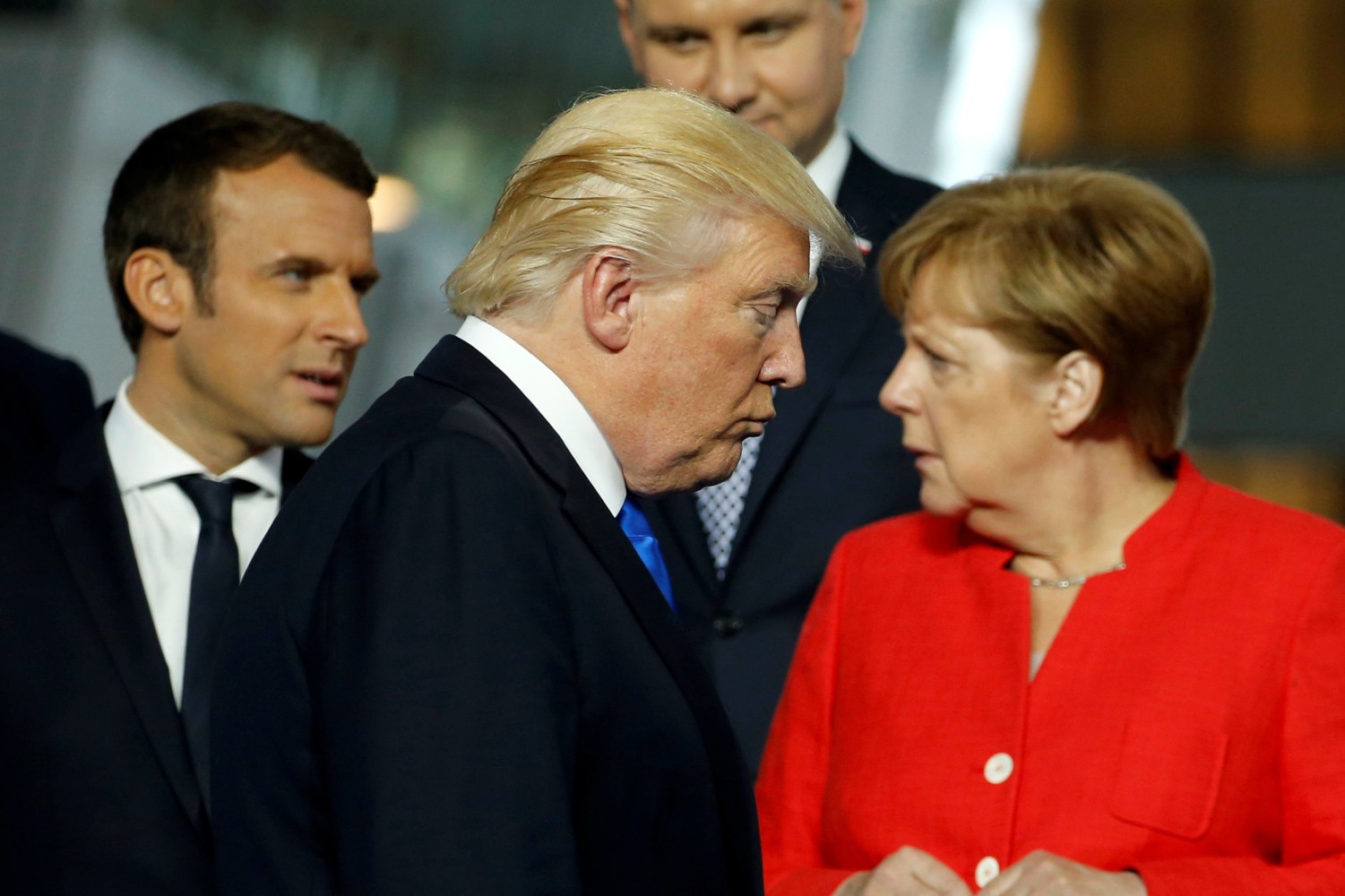
Image: President Donald Trump walks past French President Emmanuel Macron and German Chancellor Angela Merkel
172605-trump-g7-802a-rs_c20938a0fd6fa7cf4bd2c57797852f81.nbcnews-ux-320-320.jpg
President Donald Trump walks past French President Emmanuel Macron and German Chancellor Angela Merkel during the NATO summit in Brussels, Belgium, on Thursday. Jonathan Ernst / Reuters
Ahead of Thursday's speech, The New York Times quoted an administration official who was "briefed on the president's planned remarks" and said that Trump would make the promise.
But his speech stopped short of doing so.
Trump thanked other members for their support following 9/11 — "our NATO allies responded swiftly and decisively" — but was far from explicit on Article 5.
The president's spokesman, Sean Spicer, told reporters afterward that Trump's mere attendance was a tacit acknowledgement of his commitment to the mutual-defense clause.
"We all understand that by being part of NATO we have treaty obligations and commitments that we made as being part of NATO," Spicer said. "So to have to reaffirm something by the very nature of being here and speaking at a ceremony about it is almost laughable."
Many experts disagree.
Any sign that the U.S. might blink first could be taken as a signal by Russian President Vladimir Putin that cracks are appearing in NATO, according to many Western analysts.
"Article 5 is the whole point of NATO," said James Nixey, head of the Russia and Eurasia program at London's Chatham House think tank. "Articles 1, 2, 3, and 4 are all about talking. Article 5 is all about action — it's the only article that really means anything."
Although talk of all-out-war between America and Russia may seem remote, the possibility that Moscow may try to extend its influence in Eastern Europe had increased in recent years, according to many Kremlin-watchers.

GQGhc1cj_bigger.jpg
Putin will be thrilled at Trump's refusal to endorse Article 5. Unimaginable under any other president.
Some of the countries that are now in NATO were formerly part of the Soviet Union, a communist bloc controlled by Moscow whose disintegration Putin has called "a major geopolitical disaster of the century."
The Russian president enjoys sky-high domestic popularity — all built on his self-styled image as a man who can restore Russia to its former glory. He sees NATO as a Western encroachment on Russia's borders.
In March, NBC News traveled to Latvia, one of the former Soviet countries now in NATO.
Some people living there, around 20 miles from the Russian border, said they felt Trump's ambivalence toward NATO put them in danger of increased Russian influence. They feared a similar fate as Ukraine, which has been fighting rebels allegedly backed by Russia for the past three years.
Trump is hardly the first president to press NATO allies to spend more.
NATO recommends that each nation spend 2 percent of its gross domestic product on defense. Only five of the 28 members currently do so — the U.S., Greece, Estonia, the U.K. and Poland.
Trump railed against this shortfall Thursday, telling the audience in Brussels that it was "not fair to the people and taxpayers of the United States." 
His words echoed those of President Barack Obama, who just last year accused NATO members of being "complacent" and told them to dig deeper into their wallets. 
What's different with Trump is that no other president has accompanied this plea with an ultimatum: Pay up or we won't protect you. 
Nixey, at Chatham House, agreed that "European states have to pay up more." 
But whatever the cost, NATO has always been a trade-off between the U.S. and its smaller allies. Washington protects them and in return gets stability and security along its allied border with Russia and beyond. 
"It depends whether you believe that America has a role to play in global security," Nixey said. "If you do, then NATO is critical." 
At its heart, the alliance is "all about values," he added. "Most NATO states are committed to democracy. Once you start to undermine the alliance then the whole post-Cold War order breaks down." 

NBC News

Thursday, May 25, 2017

Manchester Bombing: Trump Calls Alleged Intel Leaks ‘Deeply Troubling’ - NBC News

NEWS MANCHESTER CONCERT EXPLOSIONMAY 25 2017, 11:26 AM ET
Manchester Bombing: Trump Calls Alleged Intel Leaks ‘Deeply Troubling’
by ERIK ORTIZ
President Donald Trump said Thursday that alleged intelligence leaks that have surfaced after the Manchester Arena bombing are "deeply troubling" and has ordered the Justice Department to review who's behind them.
Trump's statement, released by the White House during a summit with world leaders, didn't mention Monday night's terror attack in Manchester by name, but comes after British Prime Minister Theresa May said she would tell her American counterpart that security intelligence must remain tightly held between the longstanding allies.
British authorities are continuing to investigate the suicide bombing outside of an Ariana Grande concert that killed 22 and was carried out by a Manchester-born man whose family is accused of having terrorist ties in Libya, officials said.
Photos were published by The New York Times on Wednesday of evidence collected from the carnage — a public display that British counterterrorism officials strongly objected to because they said it "undermines our investigations."
A senior U.S. law enforcement official told NBC News that the same photos were provided by British authorities to American investigators. The Times didn't disclose how it obtained the photos.
Frustrated British police investigating the attack responded that they would stop sharing information with United States law enforcement, the BBC first reported.
May also said she will make clear to Trump during Thursday's NATO summit in Brussels that she wants the countries' shared intelligence to be protected.
"We have a special relationship with the USA. It is our deepest defense and security partnership that we have. Of course that partnership is built on trust, and part of that trust is knowing that intelligence can be shared confidently," May said.
Trump reiterated in his statement that he wants the Justice Department to review the matter and any culprits would be "prosecuted to the fullest extent of the law." 
"The alleged leaks coming out of government agencies are deeply troubling," Trump said. "These leaks have been going on for a long time and my Administration will get to the bottom of this." 
The president has repeatedly expressed aggravation with high-profile leaks concerning his administration, some that played a part in the resignation of national security adviser Mike Flynn. In February, Trump directed the Justice Department to investigate "criminal leaks" and claimed those leakers were holdovers from the Obama administration. 
Trump, while in Jerusalem on Tuesday, condemned the Manchester bombing and said "dozens of innocent people, beautiful young children, [were] savagely murdered in this heinous attack upon humanity." 

The suspected bomber was identified as 22-year-old Salman Abedi.