|
Posted: 13 Apr 2017 03:00 AM PDT
In a bid to lure millennials, the U.S. military is making the most sweeping changes to its retirement program since World War II. Gone are the days when only a 20-year veteran leaves the service with a nest egg. Going forward, those who serve as little as two years will return to civilian life with retirement savings. The new system introduces 401(k)-type savings for military personnel while downsizing the traditional pension benefit—a trade the corporate world has been making for 35 years. The new design also comes with a stepped-up effort to provide service members with the education they will need to make the most of a system that demands more individual involvement. The new Blended Retirement System, authorized through the National Defense Act of 2016, goes into effect on Jan. 1, 2018. Those who enroll in the military after that date will be put into the new blended plan. Anyone with less than 12 years of service on that date will have one year to choose between the old system and the new one. Those with more than 12 years of service will remain under the old plan. Under the new plan, 85% of those serving in future years will leave with a portable retirement benefit, the military says. That compares to less than 19% that leave with a benefit under a system that has been in force since the days of MacArthur and Patton. The switch highlights some of the tradeoffs between defined-benefit pensions and defined-contribution 401(k)s that workers in private industry have been grappling with for decades. Pension plans can provide worry-free income for life, but the benefits go mostly to long-tenured workers. With savings plans, far more people get a retirement nest egg. But much of the responsibility for diligently saving and for making reasonable investment choices rests with the workers themselves. The military employs 1.4 million men and women, many of whom struggle with the demands of serving and managing their financial affairs at the same time. Veterans of all the armed services are twice as likely as civilians to carry debt from month to month, according to a recent financial literacy survey conducted by Harris Poll for the National Foundation for Credit Counseling. More than half say they are unprepared for a financial emergency. Such figures prompted the federal government to order all branches of the military to take steps to improve the financial capability of service members. “When I was battery commander in Germany, soldiers were purchasing encyclopedias and $2,000 washer-dryers,” Michael Meese, chief operating officer of the American Armed Forces Mutual Aid Association, a nonprofit helping service members with financial issues, has said. “Then they return home to a pile of debt.” The military now provides financial counseling at most bases on such things as managing bank accounts, living on a budget and avoiding debt. Before deployment, all service members now must attend a financial preparedness class, which includes explanations on how to access bank accounts from overseas, ways to pay bills remotely, powers of attorney, wills, and death benefits. All current and future service members remain eligible for a lifetime annuity after 20 years of service. For those in the new blended plan, that annuity benefit will be 20% less than under the old pension plan. But those service members will have the benefit of also being enrolled in the government’s giant Thrift Savings Plan, where they will receive a contribution of 1% of base pay beginning almost immediately. They fully vest in the TSP in two years, meaning they can take all those dollars with them if they leave the service at that point. They will also receive a matching contribution of up to another 4%, depending on their own contributions and length of service. Most importantly, the new plan ensures that most service members get a retirement benefit, an incentive to help recruit millennials who are less likely to want long-term military careers. Military officials concede that cutting pensions for those with 20-plus years of service might lead to more service members not sticking around. But attracting millennials is the main objective. For the government, the savings don’t hurt either, says Meese. The U.S. will save about $2 billion annually under this system and may be using it as a trial balloon. “This is the first time since the 1983 reforms to Social Security that the federal government has actually cut entitlements,” he told me in an email. “I wonder if the military taking the lead in entitlement reform will lead to similar reforms in Social Security or Medicare.” Change might be coming on a broader scale than just for those who serve. |
Tuesday, April 18, 2017
The Military Is Revamping Its Retirement System to Attract Millennials - TIME


Monday, April 17, 2017
Facebook targets 30,000 fake accounts in France - CNN
Facebook targets 30,000 fake accounts in France
By Ivana Kottasova April 14, 2017: 3:18 PM ET
Facebook has cracked down on 30,000 fake accounts in France ahead of the country's pivotal presidential election. Facebook said the accounts were spreading fake news stories, spam, misinformation or other deceptive content.
"Our priority, of course, is to remove the accounts with the largest footprint, with a high amount of activity and a broad reach," Facebook security manager Shabnam Shaik said in a blog post.
The social media giantacknowledged, however, that the purge will not remove all accounts that are spreading fake news. "We know we have to keep getting better," said Shaik.
"These accounts were targeted because they are fake. Full stop," a Facebook spokesman told CNNTech. He said that taking down fake accounts helps prevent hoaxes, spam, political trolling and fake news.
"We routinely focus on these types of improvements. It's an ongoing effort and challenge," he said.
The spread of fake news has raised concerns in France ahead of the country's national elections. The first round of the voting, scheduled for April 23, will feature candidates including far right National Front leader Marine Le Pen.
Le Pen is expected to perform well enough to earn a place in a runoff scheduled for May 7.
Facebook on Thursday also took out newspaper ads with tips for spotting fake news in major publications in France and Germany.
The crackdown by Facebook (FB, Tech30) represents a major shift in policy from only a few months ago, when the role of fake news in electoral politics came under scrutiny following Donald Trump's surprise victory.
Immediately following the vote, Facebook CEO Mark Zuckerberg said his company was not responsible for influencing people's votes.
"Personally, I think the idea that fake news on Facebook -- of which it's a small amount of content -- influenced the election in any way is a pretty crazy idea," he said.
But public pressure has forced Facebook and other social media companies to rethink their role in the public debate, and many have implemented measures in recent months designed to discourage the spread of fake news.
Facebook recently began warning users that certain stories have been "disputed by fact checkers." It has also made it easier for users to report fake news and sought to undercut the business model used by publishers of fake news.
In France, media newsrooms have partnered with Google News Lab and the nonprofit First Draft News to identify and quickly debunk hoaxes and false claims as part of a program called "CrossCheck."
The initiative has debunked dozens of fake news and myths since it started in early February.
Germany, which will also hold national elections later this year, has also cracked down on fake news.
The German cabinet approved a plan earlier this month to start fining social media companies as much as as €50 million ($53 million) if they fail to quickly remove posts that breach German law.
CNNTech's Kaya Yurieff contributed to this story.
Erdogan’s new powers will spark fears of creeping authoritarianism - Independent
Erdogan’s new powers will spark fears of creeping authoritarianism
It was never going to be simple
- Chris Stevenson
- Monday 17 April 2017 00:23 BST
It was never going to be simple.
Turkey faces a complicated web of problems – a rekindled war between the state and Kurdish militants, repeated attacks claimed by Isis stemming from the country’s role in the Syria conflict, and the state of emergency that is still in place following the failed coup against the government last year.
However, for President Recep Tayyip Erdogan, the unstable nature of his country has enabled him to project the strongman image that may just allow him to extend his powers.
Those sweeping new powers will turn the largely ceremonial presidential role he now holds into a nearly all-powerful position as head of government, head of state and head of the ruling party.
READ MORE
- Turkey's Erdogan 'claims victory in vote to give him new powers'
- Erdogan signs decree on laser hair removal to win beautician votes
- Critics of President Erdogan tell of intimidation ahead of referendum
- Dutch citizens 'barred from leaving Turkey'
The presidential position was created to be neutral, with the holder of the post expected to cut all ties with their party. In appearance at least, Mr Erdogan did that in 2014, when he became the first person directly elected into the position instead of being chosen by parliament. That ended 11 years as Prime Minister and head of the Justice and Development party (AKP) he helped found.
However, the former prime minister said he wanted to be an “active” president, something that has been on his mind for a while, and as for giving up on the leadership of the AKP, he pulls too many strings for that to be anything more than window dressing.
The constitutional change for an executive presidency had been mooted by his ruling AKP back in 2011, with Prime Minister Erdogan being unable to run for a fourth term – and its adoption now would open the door for Mr Erdogan to rule possibly until 2029.
To his supporters Mr Erdogan is a man who has given a voice to the working and middle-class religious Turks who had felt marginalised by the country's Western-leaning elite. He was seen to have ushered in a period of stability and economic prosperity, building roads, schools, hospitals and airports in previously neglected areas.
Others see him as pushing too much of a religious line in a nation that was built on the secular aspirations of Turkey’s modern founder Mustafa Kemal Atatürk.
The constitutional amendments would give the president the power to appoint ministers and government officials, to name half the members of the country's highest judicial body, to issue decrees and to declare states of emergency.
That raises the alarm for many. Mr Erdogan has long-faced accusations by critics of using the judiciary to silence opponents, and journalists groups have often spoken out of the stifling of their freedom to report – with many more civilians worried about the implications of a move to ‘one-man rule’. Hence the close result in the referendum.
Despite what many citizens see as Mr Erdogan’s commitment to the safety of his country’s citizens from the multitude of threats they currently face, as he has become more powerful, his critics say he has become increasingly authoritarian.
His election campaigns have been forceful and bitter, with Mr Erdogan lashing out at his opponents, accusing them of endangering the country and even supporting terrorism – either in Syria or the insurgency of the Kurdistan Workers’ Party (PKK).
After surviving the attempted coup in July he launched a wide-ranging crackdown on followers of his former ally, Islamic cleric Fethullah Gulen.
Mr Erdogan and his government blame Mr Gulen, who lives in the United States, and his supporters for plotting the coup, an allegation the cleric has denied.
The crackdown saw roughly 100,000 people lose their jobs, including judges, lawyers, teachers, journalists, military officers and police. More than 40,000 people have been arrested and jailed, including pro-Kurdish MPs.
Hundreds of non-governmental organisations and news outlets have been shut down, as have many businesses, from schools to fertility clinics.
It is fears over Mr Erdogan having free rein to push further with such purges that may be one of the reasons opposition parties are appealing the result – the will of the people is fine, but there must be no hint of any foul play.
Outside of Turkey, the EU will likely be worried, with several nations, including Germany and the Netherlands having clashed with Mr Erdogan over campaigning for Sunday’s referendum. There is also the small case of potential talks over Turkey’s ascension to the EU, stopped over Mr Erdogan’s apparent support for the return of the death penalty in the wake of the attempted coup. A theme that Mr Erdogan has returned to in remarks following the referendum vote results.
The EU also needs Turkey’s help in dealing with the refugee crisis in the bloc, and stemming the flow of new arrivals – a thorny issue that will not disappear. The potential new reality in Turkey will certainly create difficulties, with decisions potentially based on the whim on the President.
But as supporters of Mr Erdogan pour onto the streets of Istanbul and other cities, in a similar way to the night of the attempted coup which helped to stifle the insurrection – it appears Turkey’s President will emerge the victor, not matter how many appeals come in over the result of the referendum vote – just as he has many times before.
US claims success in test drop of upgraded nuclear weapon - Independent
US claims success in test drop of upgraded nuclear weapon
'It's great to see things all come together: the weapon design, the test preparation, the aircraft, the range and the people who made it happen' said the director of Sandia's Stockpile Resource Center
- Susan Montoya Bryan
- Saturday 15 April 2017 12:11 BST
Scientists at Sandia National Laboratories are claiming success with the first in a new series of test flights involving an upgraded version of a nuclear bomb that has been part of the US arsenal for decades.
Work on the B61-12 has been ongoing for years, and government officials say the latest tests using mock versions of the bomb will be vital to the refurbishing effort.
An F-16 from Nellis Air Force Base dropped an inert version of the weapon over the Nevada desert last month to test its non-nuclear functions as well as the plane's ability to carry the bomb.
With a mere puff of dust, the mock bomb landed in a dry lake bed at the Tonopah Test Range.
"It's great to see things all come together: the weapon design, the test preparation, the aircraft, the range and the people who made it happen," Anna Schauer, director of Sandia's Stockpile Resource Center, said in a statement.
Scientists are planning to spend months analysing the data gathered from the test.
Tracking telescopes, remote cameras and other instruments at the test range recorded information on the reliability, accuracy and performance of the weapon under conditions that were meant to replicate real-world operations.
More test flights are planned over the next three years, and officials with the National Nuclear Security Administration said the first production unit of the B61-12 — developed under what is called the Life Extension Program — is scheduled to be completed in 2020.
The B61-12 consolidates and replaces four older versions in the nation's nuclear arsenal. It's outfitted with a new tail-kit assembly and other hardware.
The weapon is much different than the non-nuclear "mother of all bombs" used in Afghanistan this week to attack an Islamic State stronghold near the Pakistani border. The Massive Ordnance Air Blast bomb, or MOAB, isn't designed to penetrate like the B61-12 but rather create a large blast over the surface and it has to be ferried by a much larger plane given its size.
Sunday, April 16, 2017
North Korean Missile Launch Fails ‘Almost Immediately’ - NBC News
NEWS APR 15 2017, 10:07 PM ET
North Korean Missile Launch Fails ‘Almost Immediately’, U.S.Military Says
by COURTNEY KUBE, KELLY O'DONNELL andSTELLA KIM
North Korea attempted a missile launch early Sunday morning local time (5:21 p.m. ET), but it failed "almost immediately" United States military officials confirmed to NBC News.
South Korea's military detected the same results, according to South Korea's Yonhap news agency.
The launch was attempted from Sinpo, a city on North Korea's east coast, some 400 miles from Japan, according to U.S. Pacific Command.
Early assessments suggested the projectile was not the feared intercontinental ballistic missile (ICBM) capable of reaching the continental U.S., two U.S. military officials told NBC News.
The attempted launch comes just one day after the North held a massive parade to display is military might, including what experts said appeared to be new capabilities for long-range ICBMs. It marks the second time in as many months that a North Korean missile ended in an embarrassing explosion just after launch.
President Donald Trump, who is at his Mar-a-Lago resort in Palm Beach, Florida, this weekend, was briefed on the launch, a senior White House official told NBC News.
"The president and his military team are aware of North Korea's most recent unsuccessful missile launch. The president has no further comment," Secretary of Defense James Mattis said in a statement Saturday night.
"U.S. Pacific Command is fully committed to working closely with our allies in the Republic of Korea and in Japan to maintain security," the military said in an earlier statement on Saturday.
Vice President Mike Pence was en route with his wife and two daughters to Seoul, South Korea, Tuesday night for meetings with U.S. and South Korean troops and acting President Hwang Kyo-ahn. Pence's schedule was not expected to be altered, a senior White House officials said.
Shin In-kyun, President of Korea Defense Network a civic group specializing in military affairs, told NBC News that Sinpo is North Korea's submarine port and the failed missile was likely a submarine-launched ballistic missile (SLBM).
"SLBMs are more threatening than any other type of missile of the same range because it can evade radar detection, including the THAAD," Shin said, referring to the Terminal High Altitude Area Defense anti-missile system provided to South Korea by the U.S. "If North Korea [can] complete building 3,000-ton submarine, they can then attack Guam, Hawaii and even Alaska with an SLBM."
South Korea's National Security Council was set to convene Sunday morning local time (8:30 p.m. ET) "to examine the security situation regarding the missile launch by North Korea," a South Korean presidential spokesperson told NBC News.
Saturday, April 15, 2017
North Korea's nuclear arsenal is real – how Trump will handle it is unknown - Guardian
North Korea's nuclear arsenal is real – how Trump will handle it is unknown
Julian Borger in Washington
Saturday 15 April 2017 03.14 AEST Last modified on Saturday 15 April 2017 19.40 AEST
The ascent of Donald Trump, the volatility of his foreign policy and his tendency to fire off tweeted threats to nuclear-armed adversaries has brought one more wild card to the Korean peninsula, which already had more than its fair share.
China urges North Korea and US to step back from brink of war
Read more
Tensions would be high anyway in the run up to Saturday’s “Day of the Sun”, when the North Korean state celebrates the anniversary of the birth of its founder, Kim Il-sung. His grandson, Kim Jong-un, has shown himself anxious to outdo his forefathers, accelerating the pace of the regime’s missile and nuclear tests.
Very visible work has been under way at the mountainous nuclear test site where a new tunnel has been opened, giving rise to expectations that the country could carry out its sixth underground detonation of a nuclear device. This time, it could be a thermonuclear weapon that is tested, with a far higher yield than a simple fission warhead, or more than one bomb could be set off at the same time.
Alternatively, the preparations could be feint, intended to confuse and frighten the rest of the world, and Kim could use the grand military parade on the Day of the Sun to show off an intercontinental ballistic missile (ICBM), which the regime is seeking to develop and would be capable of reaching the west coast of the US.
There has been little doubt in recent years that the end-point of the North Korean programme is an arsenal of working ICBMs and nuclear warheads small enough to put on top of them. The dilemma of how to stop it reaching that goal is the hardest problem facing any US administration, a point that Barack Obama repeatedly made to Trump during the presidential transition.
How Trump will handle that challenge is the greatest unknown hanging over the region. His instinctual response has been to bluster, mostly on Twitter, insisting that the North Korean development of an ICBM just “won’t happen” and warning that if the Chinese did not do more to stop the forward march of Pyongyang’s programme, “we will solve the problem without them”.
He has described US naval deployments of aircraft carriers and submarines in the region as an “armada”, while his secretary of state, Rex Tillerson, has declared that the Obama era of “strategic patience” is over.
Rattling sabres is a particularly dangerous thing to do on the Korean peninsula. While the repercussions from a missile strike in Syria or the dropping of a giant bomb in Afghanistan can be contained, a preventative strike on North Korea could set off a chain reaction. In wargaming such a confrontation, US military planners under Obama came to the conclusion that Pyongyang’s most likely counter-move would be demolish Seoul with its artillery lined up behind the demilitarised zone separating North and South Korea.
The US and North Korea have thus been stuck in a position of mutual deterrence, which has stopped the outbreak of major new hostilities but not prevented Pyongyang’s steady advance towards the capacity to directly threaten the continental US, and Europe for that matter, with nuclear weapons.
Let's stop calling North Korea 'crazy' and understand their motives
Isaac Stone Fish
Read more
Trump seems to be hoping that by introducing some unpredictability into this static scenario, he can frighten the Chinese government into putting real pressure on Pyongyang. There are some signs that might be working, with hints in China’s semi-official media that Beijing could tighten oil deliveries, North Korea’s lifeline.
If that fails however, and Kim’s instincts up to now have always been to defy pressure, Trump is left with the same dilemma as Obama, but perhaps with even further to walk to any future negotiating table.
A Giant U.S. Bomb Carries an Even Bigger Message - New York Times
A Giant U.S. Bomb Carries an Even Bigger Message
By ERIC SCHMITT, HELENE COOPER and C. J. CHIVERS
APRIL 14, 2017
WASHINGTON — The bomb that the United States dropped on an Islamic State cave complex in Afghanistan on Thursday was big — at 22,000 pounds, the most powerful conventional weapon in the American arsenal. Arguably, even bigger were the messages it sent, whether by design or not.
To potential adversaries like Syria and North Korea, the bombing could signal deterrence. For the American public, it underscored the Pentagon’s more aggressive stance under President Trump than under his predecessor, whose administration never even debated using the weapon.
Dozens of militants were killed, Afghan officials said. American commanders said that the bomb was chosen because it fit the target, a series of tunnels with dug-in positions nearby used by militants in a remote part of eastern Afghanistan, and that it posed little or no risk to civilians. The bombing spared troops from fierce fighting in caves.
It also illustrated how Mr. Trump is releasing commanders from Obama-era restrictions on the use of force and how the top United States commander in Afghanistan, Gen. John W. Nicholson Jr., was seeking to showcase Afghanistan’s myriad threats. General Nicholson, who has requested reinforcements to the 8,500 American troops stationed there, drew his bosses’ attention by dropping what the Pentagon has nicknamed the “mother of all bombs.”
“Another promise kept,” Donald J. Trump Jr., the president’s son, said on Twitter, noting his father’s campaign promise to vigorously strike the Islamic State and using an emoji of a bomb with a lit fuse.
Using the weapon, called the GBU-43/B Massive Ordnance Air Blast, or MOAB, presents special challenges. It can obliterate everything within a 1,000-yard radius. The ordnance contains almost 19,000 pounds of Composition H6, an explosive compound that is roughly one-third stronger than an equivalent weight of TNT.
In Afghanistan, with its rural and agrarian economy, civilians who are engaged in food-gathering, woodcutting, farming or tending herds are often near or beside concentrations of militants. The blast radius of an explosion of this size could pose risks to people far from the center of the target.
For that reason, President Barack Obama’s administration did not consider using the bomb, American officials said. Early in the Iraq war in April 2003, during the administration of President George W. Bush, American commanders weighed using the weapon to try to kill President Saddam Hussein, who was on the run from United States troops who had toppled his government.
But commanders discarded the option when analysts estimated that the bomb’s blast would also kill thousands of civilians. “The collateral damage would have been massive,” said Marc Garlasco, who led a team in the military’s Joint Staff that was seeking to target Mr. Hussein.
The Afghan government said Friday that 36 militants were killed in Thursday’s blast. That number has not been independently verified, and official Afghan government casualties estimates have been unreliable in the past. Another official put the number of dead militants at more than 80.
Early reports from the area near the blast did not suggest that any civilians had been killed and said that most civilians had left the target area in recent weeks because of continuing fighting between the militants and Afghan forces and American troops.
The attack seemed to have a limited purpose and to be less significant than implied by the news coverage that focused principally on the unusually large size of the bomb.
By comparison, under Mr. Obama, the Air Force killed more than 100 Qaeda militants in Syria in the waning hours of his presidency by dropping bombs with no memorable name from B-52 planes.
General Nicholson said Thursday’s attack was tactically necessary to defeat obstacles, hidden bombs and the dug-in positions used by the militants. “Therefore, this was the appropriate weapon to use at this time,” he said.
But the Islamic State’s regional affiliate in Afghanistan, largely made up of former members of the Pakistani Taliban, numbers only some 700 fighters, compared with a peak of 2,000 to 3,000 in the spring of 2016.
The Trump administration has not publicly articulated a thorough long-term plan or endgame for the Afghan war and faces harsh circumstances in a conflict beset by starts and stops, troop commitments and withdrawals, and a series of disappointments and failures over more than a decade and a half of varied missions, priorities and even doctrines.
Many of the areas where American troops and their allies have fought hard and died in large numbers have fallen or reverted to militant control in recent years. The Afghan security forces, created with American training, money and weapons, have not lived up to the Pentagon’s promises.
The pace of airstrikes has increased, and Thursday’s bombing served as an example of a new weapon being applied to the war. But past airstrikes, while they have killed an uncountable quantity of militants, have not prevented their organizations from regrouping and refilling their ranks. And in this case, the use of the powerful bomb — whether it was seen internationally as a signal of a renewed American intention of using force — could also be read as an option that commanders viewed as necessary because they have limited resources on the ground.
While some analysts said the bombing sent a stern symbolic message to Syria and North Korea, it has little real utility against those countries, or Iran or Russia, because it is pushed out of a lumbering cargo plane that can operate safely only over nations that have no effective air defenses or air forces.
Some critics said the bombing could send an unintended message to North Korea that may unnecessarily rattle nerves in Pyongyang at a time of high tension for no clear strategic reason, while failing to advance a long-term strategy in Afghanistan.
“Let’s not confuse this tactic for a strategy,” said Representative Seth Moulton, a Massachusetts Democrat and former Marine Corps captain who served four tours in Iraq.
At the Pentagon, military officials said that they did not need to request authorization for the strike from Mr. Trump, although three officials also acknowledged that if Mr. Obama had still been in charge, the Defense Department would probably have sent the proposal to the White House before proceeding.
But instead of the deliberative processes in place during the Obama administration that made for lengthy National Security Council staff meetings, Mr. Trump has approved allowing his commanders more authority, giving the Pentagon a rare freedom to assert its control over national security policy from a commander in chief who eschews quibbling over the details.
Eric Schmitt and Helene Cooper reported from Washington. Mujib Mashal and Fahim Abed contributed reporting from Kabul, Afghanistan, and Michael R. Gordon from Baghdad.
New York Times
These Airlines Have the Worst Customer Service - TIME Business
|
Posted: 10 Apr 2017 11:55 AM PDT
Plenty of things can make a flight unpleasant: rough skies, weather-related cancelations and delays, even tarantulas roaming the cabin mid-flight. But how an airline’s staff and crew handle these mishaps—and treats passengers—can turn an annoying (or creepy-crawly) situation into a complete nightmare. Customer service is one of the few things airlines have total control over, but poorly trained or apathetic employees can tarnish a carrier’s reputation. Every year, Travel + Leisure’s World’s Best Awards survey asks readers to weigh in on travel experiences from across the globe—to cast their votes for the top hotels, islands, cities, spas, and more. Readers ranked airlines on a number of categories, including cabin comfort, food, value, and customer service. And when it came to the latter, some carriers failed to perform in 2016. “I am not a complainer,” said T+L reader Beth McKieman. “But this was by far the worst flight experience I have ever [taken].” During her flight with Royal Air Maroc, Morocco’s national carrier, McKieman reported that a request for a tissue was met with “a glare and a shrug” from “a surly crew.” And travelers flying with the domestic budget airline, Frontier, described a remarkable drop in customer service. “This airline is on a downward slide,” said one reader, while another added: “even their once great flight attendants have become robotic and mostly uncaring.” It’s not just cranky gate agents and brusque flight attendants that account for bad customer service. Of Volaris, a Mexico-based low-cost airline, one reader postulated the mobile version of the website was specifically designed “to make you book by phone at [an] extra charge.” And don’t even get them started on the cabin comfort. Of course, there are plenty of airlines out there that are treating travelers right—and the world’s worst airlines for customer service could learn a thing or two about hospitality. No. 9 United Airlines, DomesticNo. 8 Air India, InternationalNo. 7 Egyptair, InternationalNo. 6 Volaris, InternationalNo. 5 Royal Air Maroc, InternationalNo. 4 easyJet, InternationalNo. 3 Frontier Airlines, DomesticNo. 2 Allegiant, DomesticNo. 1 Spirit Airlines, Domestic“We’ll never fly spirit again no matter what the rate,” said reader Amy Barwick of the low-cost carrier, “because you’ll end up paying the difference in further frustrations later.” Spirit continues to bottom out with T+L readers, who were routinely dismayed by the airline’s lack of customer service. “I know [flight attendants] are there for safety,” said another survey respondent, “but I’m not sure they would put passengers first [in] an emergency.” Many readers interacted with rude employees, and just as many said it’s impossible to speak with a customer service representative. Even on Twitter, “Spirit Autopilot” tries to deflect complaints with bot-generated responses.This article originally appeared on TravelandLeisure.com |
Friday, April 14, 2017
Coalition airstrike in Syria mistakenly kills 18 US-backed fighters - ABC News
Coalition airstrike in Syria mistakenly kills 18 US-backed fighters
- By ADAM KELSEY
Apr 13, 2017, 11:27 AM ET
An airstrike on Tuesday by the coalition fighting ISIS south of Tabqah, Syria, killed 18 U.S.-supported fighters, U.S. Central Command announced.
The strike killed members of the Syrian Democratic Forces, a local group of fighters that the U.S. and a coalition of 67 other nations and organizations support in the shared goal of defeating ISIS.
"The strike was requested by the partnered forces, who had identified the target location as an ISIS fighting position," CENTCOM said in a statement.
Instead, the position was occupied by members of the SDF, 18 of whom were killed as a result.
"The coalition's deepest condolences go out to the members of the SDF and their families," the statement continued. "The coalition is in close contact with our SDF partners who have expressed a strong desire to remain focused on the fight against ISIS despite this tragic incident."
The statement further said that the coalition is investigating the strike and planning to "implement appropriate safeguards" to avoid further misdirected action.
Coalition airstrikes are a regular tool in the fight against ISIS in Syria and Iraq. Syria's ongoing civil war — a conflict with origins unrelated to ISIS but during which the group has been able to make inroads in the country — has presented complications in combating the group. Last week's U.S. missile strike on a Syrian air base was the first U.S. engagement in Syria unrelated to the fight against ISIS.
ABC News' Elizabeth McLaughlin contributed to this report.
Trump’s Mar-a-Lago Travel Triggers Cost and Ethics Concerns - NBC News
POLITICS APR 13 2017, 7:30 AM ET
Trump’s Mar-a-Lago Travel Triggers Cost and Ethics Concerns
by ALI VITALI , GABE GUTIERREZ and RICH GARDELLA
PALM BEACH, Fla. — Before calling the White House home, Donald Trump used to wonder why any president would ever leave.
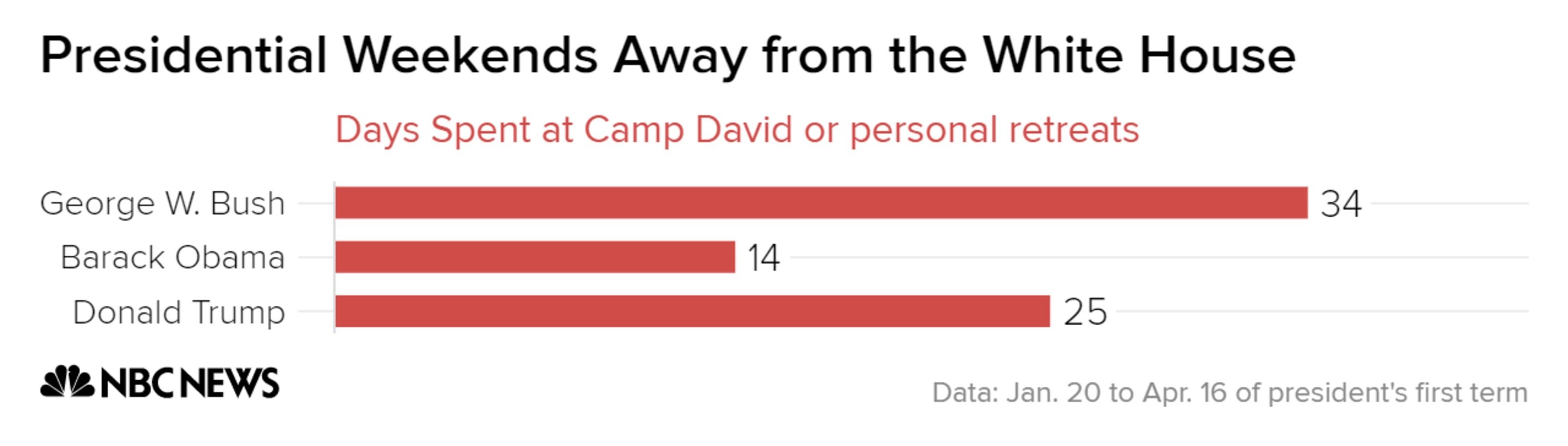
"If you're in the White House, who wants to take a vacation?" he once asked a campaign crowd in Spencer, Iowa. Noting the limited time a president has there, he criticized President Obama for vacationing "when there's so much work to be done."
"You're in the White House," he said. "What's better than the White House? Why these vacations?"
But since his January inauguration, President Trump has spent seven of 13 weekends at his Palm Beach, Florida estate. According to NBC News' estimates by Sunday Trump will have spent 28 percent of his term traveling to or staying at Mar-a-Lago. Trump hosted his second world leader at the "winter White House" last weekend, with Chinese President Xi Jinping joining Trump for meetings Thursday and Friday. Trump stayed the rest of the weekend, frequenting his nearby golf club on both days.
It's not just a question of travel time, but of ethics and cost efficiency, according to watchdog groups and ethics experts.
While presidents have always traveled on the taxpayer's dollar — the Obamas were partial to Hawaii and Martha's Vineyard while President George W. Bush frequented his Crawford, Texas ranch — Trump's travel is "unprecedented," one expert says, because he's repeatedly visiting his own privately owned commercial property at Mar-a-Lago.
"It's just another example of his consistent efforts to exploit public office for private gain," ethics expert Steve Schooner told NBC News. "He's using his official office and the fact that people have to travel with him, meet him, and follow him to promote his commercial enterprise, in this case his privately owned club."
"I can't think of anything like this that we've seen at anytime in the modern era," the George Washington Law School professor told NBC News. The Mar-a-Lago property is still owned by Trump, who placed his holdings in a trust overseen by his eldest son, Donald Trump Jr., and Trump Organization CFO Allen Weisselberg before assuming office, prompting Schooner to lament that the president "should have divested from his properties to begin with."
Since Trump became president the cost of membership at Mar-a-Lago has doubled, with guests now paying $200,000 just to join.
"This is a privately owned club that for all intents and purposes was just another golf property in Florida before, that almost now is something that Americans immediately recognize," Schooner continued. "Imagine what you would have to pay to get that kind of brand recognition. That's extraordinary."
Aside from concerns over who is profiting from Trump's trips, is the question of who's paying for them.
Over two-dozen A-listers from Trump's administration have visited the property over the past three months, along with high-level job applicants, and even New England Patriots owner Robert Kraft, among others. While passing the days in Palm Beach, Trump has been known to spend time at his nearby golf clubs, where he may or may not take the time to hit a few balls amidst meetings and phone calls.
A White House official told NBC News that when President Trump travels to Mar-a-Lago "he is staying at his home, the Southern White House, and has minimal staff with him." Hotels and meals for those federal employees involved in the trips are covered by the government, according to the official.
Even though Trump is, for the most part, working weekends, conservative watchdog group Judicial Watch thinks there are less costly ways to do it.
They estimate the cost of a back-and-forth trip from Washington to Palm Beach at about $1 million, with Air Force One costing $142,380 per hour, according to information Judicial Watch says it obtained through a Freedom of Information Act request. Other estimates put each trip's price tag as high as $3 million.
White House Press Secretary Sean Spicer has defended the travel, saying Mar-a-Lago "is where [Trump] goes to see his family. He brings people down there. This is part of being president."
Trump is not the only president to rack up a high tab while traveling, however. Though the White House wouldn't say exactly how much Trump's trips cost him, estimates by the Government Accountability Office show that a weekend trip taken by President Obama in 2013 to Chicago and South Florida cost about $3.6 million.
Still, Judicial Watch President Tom Fitton says the cost to taxpayers in either case is too high, calling for Trump "to try to figure out ways to save money for the taxpayer" and applauding him for using his Virginia golf clubs when he's looking to get away. Fitton doesn't question that Trump's working — "whenever a president travels, he's doing work," he says — but he does "question whether it's necessary to travel to a particular place to do the work."
Fitton issued similar calls for cost awareness and transparency during the Obama years, noting now "a little bit of anti-Trump animus" in the media's criticism of Trump's presidential travel.
The use of Mar-a-Lago to host foreign leaders, however, is justifiable in his eyes.
"It's the president's home," Fitton told NBC News. "It's probably a nice way to visit with leaders and get to know them and to do some important business with them. So it's not the end of the world that he hosts the president of China, or anyone else, down there."
In addition to hosting President Xi, who did not stay at Mar-a-Lago during last weekend's bilateral summit, Trump personally gifted Japanese Prime Minister Shinzo Abe a weekend-long stay at his hotel during their tete a tete several weeks ago.
The cost of Trump's summit with President Xi hit hard on a local level, with the Palm Beach County community footing the bill, an estimated $1.5 million for Thursday and Friday's U.S.-China summit.
Palm Beach County Sheriff Ric Bradshaw told NBC that each day President Trump spends in Mar-a-Lago costs his department $60,000.
County Commissioner Dave Kerner noted Bradshaw's cost evaluations, making the point that with Trump governing from Palm Beach County, "it becomes a very significant financial burden on the taxpayers" here.
"While he may treat it like it's the Southern White House, it's not," Kerner said, worrying about skyrocketing costs that the county hadn't budgeted for. Kerner hopes for reimbursement from the federal government to offset the burgeoning bill of Trump's visits to the area and has even suggested turning Mar-a-Lago into a special taxing district that would impose a levy on the resort to pay the president's security costs,according to an Associated Press report.
Democrats have also seized on Trump's travel, using it as a chance to call for increased transparency of who's visiting with Trump at Mar-a-Lago, as well as asking the Government Accountability Office to look into taxpayer costs and security measures related to Trump's use of the property.
In the eight years of his presidency, Barack Obama's total travel costs were at least $97 million. At the current rate, the costs of President Trump's travel could well exceed that.
Subscribe to:
Posts (Atom)
