Friday, September 16, 2016

Sheryl Sandberg Apologizes for Facebook’s ‘Napalm Girl’ Incident - Fortune

Posted: 13 Sep 2016 07:39 AM PDT

Facebook COO Sheryl Sandberg has admitted that Facebook erred in removing the historic photo of a naked girl fleeing a napalm attack in Vietnam in 1972 —a decision that sparked controversy about the company’s photo standards and heightened the tension between Facebook’s role as a social platform and what it owes users as a news publisher.
Last week, Facebook deleted multiple copies of the iconic image by Nick Ut and suspended user accounts after a Norwegian newspaper editor posted the picture as part of a series on war photography. The editor-in-chief of the paper, Aftenposten, decried the move by Facebook in an open letter to CEO Mark Zuckerberg. “Dear Mark. I am writing this to inform you that I shall not comply with your requirement to remove this picture,” he wrote.

Facebook, which bans nudity in most cases, later reinstated the Pulitzer Prize-winning photo and said in a statement that, in the case of the napalm girl photo, the image’s “status as an iconic image of historical importance” and the “value” of permitting users to share it “outweighs the value of protecting the community by removal.”
In its scramble to censor the photo, Facebook ended up removing it from the account of Norwegian Prime Minister Erna Solberg, which prompted Solberg to accuse Facebook of editing history. Norway owns 0.52% of Facebook—a stake worth some $1.54 billion—through an investment by its sovereign wealth fund.
Sandberg wrote a letter to Solberg about the incident, and in doing so, hinted at how Facebook views its on-going efforts to police potentially offensive content. In the letter obtained by Reuters on Monday under Norway’s freedom of information rules, Sandberg said, “These are difficult decisions and we don’t always get it right.”
“Even with clear standards, screening millions of posts on a case-by-case basis every week is challenging,” Sandberg wrote. “Nonetheless, we intend to do better. We are committed to listening to our community and evolving. Thank you for helping us get this right.”
Solberg had welcomed Facebook’s decision to reinstate the photo last week when she told a public broadcaster that the move “shows that it helps to use your voice to say ‘we want change.’”
Sandberg said her letter signified “how seriously we take this matter and how we are handling it,” and she suggested that the prime minister’s staff could meet two Facebook officials who will be in Norway on Friday.
This article originally appeared on Fortune.com

The Collapse of a Major Shipping Firm is Causing a Trailer Shortage in California - TIME Business


Posted: 14 Sep 2016 09:21 PM PDT

The bankruptcy of Korea’s Hanjin Shipping Co Ltd is causing ripple effects for importers bringing goods from Asian factories to U.S. malls by creating a shortage of trailers to move ocean-shipping containers on U.S. roads.
The world’s seventh-largest container carrier has more than 500,000 containers, and many already are clogging up ports and truck yards, tying up trailers that cannot be used to handle other cargo. That is beginning to worry freight handlers at U.S. West Coast ports and is the first sign of knock-on effects from the failure of Hanjin.
The problem stems from Hanjin’s shortage of cash, which has stranded $14 billion of cargo owned by companies such as HP Inc , Home Shopping Network and Samsung Electronics Co Ltd. Much of the cargo is on more than 100 ships at sea because cargo handlers, tug operators and ports are refusing to work with Hanjin unless they get paid up front.
A lawyer for the shipper did not immediately respond to a request for comment.
Terminal operators in the California ports of Long Beach and Oakland are not taking back empty containers. Many in the industry doubt Hanjin will pay storage costs, and a growing number of empty containers and the trailers they sit on are stranded.
“If it’s not fixed in the next couple of weeks, I think you’ll see a huge ripple effect across the industry,” said Weston LaBar, executive director for the Harbor Trucking Association in Long Beach, California.
LaBar said there are thousands of Hanjin containers on trailers out of circulation, and the uncertainty surrounding Hanjin appears to be pushing truckers to lock in trailers from his organization’s pool.
“We doubled in bookings this morning,” LaBar said. “We have availability, but we’re getting to the point where we may be leased out for our chassis.”
Shipping executives said there is ample supply of shipping containers, but trailers are limited. The West Coast ports previously have experienced brief shortages even when the stream of trade is functioning normally.
The Hanjin collapse has exacerbated the problem.
At GSC Logistics Inc, Chief Executive Officer Scott Taylor said he is stuck with nearly 80 empty Hanjin containers on trailers, racking up charges for cargo owners, that his company processed recently and could not return to a terminal operator at the Port of Oakland.
“If it says Hanjin on the side, there’s no place for it to go right now,” said Taylor.
Grocery chain Kroger Co told Reuters it has 880 shipping containers tied up on Hanjin ships. The company’s lawyer, Ron Leibman, on Friday told a U.S. judge who is overseeing Hanjin’s U.S. bankruptcy case that Kroger does not expect to be able to return the containers once it receives its products, creating a headache and added costs for the company.
Empty containers were sitting on trailers, said Jonathan Gold, vice president of supply chain and customs policy for the National Retail Federation. “This is causing problems with the terminal operators and truckers who need the equipment” to haul full containers, he said.
Karen Vellutini, a vice president at Devine Intermodal, a trucking company in West Sacramento that services the Port of Oakland, said she expects the availability of trailer chassis to become a problem as the holiday season nears and as more Hanjin ships arrive in ports and unload containers.
“We’re not seeing it yet, but it’s inevitable,” Vellutini said. “This problem is going to compound.”
In Southern California, shipping industry executives are discussing setting aside a staging area where truckers could drop off empty containers to free up trailers, said Mario Cordero, chairman of the Federal Maritime Commission, which regulates carriers, terminal operators and ports.
“They are trying to address what could be even a greater crisis as these numbers mount,” Cordero said.
“If those chassis get all occupied, or a good percentage of them, where the containers are just sitting on them with nowhere to deliver, that disrupts the supply chain,” Cordero said. “We are certainly reaching the level we are concerned.”
The commission is monitoring prices to make sure fees for leasing trailers do not become excessive amid the Hanjin problems, Cordero said.
Vellutini of Devine Intermodal said cargo owners could resort to buying the containers they are holding to clear up any legal uncertainty around them and to return chassis.
“People are waiting for the dust to settle to decide if they’ll buy and get into the used container business.” 
(Writing by Tom Hals in Wilmington, Delaware, additional reporting by Tom Hals, Nandita Bose, and Jessica Resnick-Ault; editing by Peter Henderson and Cynthia Osterman)

Thursday, September 15, 2016

Samsung will replace all Galaxy 7 note books - CNN

Samsung issued replacement guidance statement on Galaxy Note 7 users on Saturday: Turn off the phone and bring it in for a replacement phone.

The message comes a week after Samsung announced it would immediately stop selling the phone and replace the 2.5 million it had already sold. 
Samsung (SSNLF) is not calling what it is doing a recall and instead labels it a "global replacement program." But, let's face it, it's a recall. Both Verizon (VZ, Tech30) and AT&T (T, Tech30) are calling it a recall on their websites. 
Samsung didn't respond to CNNMoney's request for comment. So we reached out to the U.S. call center and a representative said Note 7 users should power off the phone and bring it back to the retail location where it was purchased. Customers must bring the phones with them to receive a refund or a different model. 
Here's what you should know:
What's the problem?
There's a risk that the Note 7 can catch fire while charging due to problems with the battery. The issue is only believed to affect 0.1% of all devices. 
Samsung said last week that it had found only 24 phones to be defective. 
In the U.S., the Consumer Product Safety Commission urged users to power down their phones and said it would be providing guidance about an official recall "as soon as possible." 
The "exchange program" comes as rival Apple unveiled its new iPhone 7 on Wednesday. Samsung is the world's biggest selling smartphone maker. 
The Note 7 went on sale in August. 
What countries are affected?
Sales of the Note 7 were halted last week in 10 countries: the U.S., Canada, Mexico, Puerto Rico, Australia, New Zealand, Singapore, Taiwan, the UAE and Korea. 
However, notices of the return program were posted on Samsung's global website as well as those of several countries not listed in initial statements about the battery problem. 
Phones in China don't appear to be affected because they have a different battery. 
What should you do?
Samsung "strongly" advised customers to power down their phones and participate in the program in a statement posted on their global website. 
Customers are advised to contact their local call centers or visit the retail location where the phone was purchased. In the U.S., customers can call 1-800-SAMSUNG or 1-800-726-7864. 
Customers have the option to replace their phone with the Galaxy S7, the Galaxy S7 Edge or a different device and receive reimbursement for the difference. 
For Note 7 holders who would prefer to wait for a new model, they will receive a Samsung J Series loaner phone until the new model is released. New Note 7 phones will need CPSC approval before they can be released in the U.S. 
Note 7 accessories can also be returned for a refund and Samsung is issuing a $25 gift card, in-store credit or bill credit to users for the inconvenience. 
Can I take it on a plane?
Note 7 users can take their phones on board airplanes but the phones must be powered off and cannot be connected to a charging device. 
The phones should be carried onto the plane and not stowed in checked luggage, according to guidance from airlines around the world.

Wednesday, September 14, 2016

Chevy’s New Electric Car Will Outrange Tesla’s Model 3 - TIME

Posted: 13 Sep 2016 06:36 AM PDT

DETROIT, Sept 13 (Reuters) – General Motors Co said on Tuesday its electric subcompact Chevrolet Bolt EV will have an average range of 238 miles on a full charge, farther than rival Tesla Motors Inc expects for its upcoming Model 3.
The Bolt EV will be launched in a few months, nearly a year before the Tesla Model 3, with a starting price for U.S. consumers of $37,500 that is similar to the announced starting price for the Model 3.
The sale price is before ancillary charges and a federal tax credit available to U.S. buyers that could be $7,500.

The Bolt is on track to be the first fully electric car with at least 200 miles of driving range per charge and a starting price below $40,000. Tesla’s Model S and Model X offer driving ranges of more than 200 miles, but at prices that start at roughly double the Bolt‘s.
The Bolt is also seen as the first affordable fully electric car.
The average selling price for a new vehicle in the United States is about $31,000, and GM reported that in August, its vehicles were sold to U.S. consumers at an average of $36,730. These prices reflect discount incentives to spur sales, which are not normally generous or even available for the newest of models.
GM’s share price was little changed following the expected announcement. In premarket trading on Tuesday, shares were at $31.17, a cent lower than Monday’s close.
GM has said that the Bolt, along with the plug-in hybrid Chevrolet Volt, will be made available to drivers of the ride-hailing service Lyft Inc, in which GM has invested half a billion dollars. (Reporting by Bernie Woodall; Editing by Bernadette Baum)

Wells Fargo Exec at Center of Scandal Gets Huge Payday - Fortune


Posted: 12 Sep 2016 07:40 AM PDT

Wells Fargo & Co’s “sandbagger”-in-chief is leaving the giant bank with an enormous pay day—$124.6 million.
In fact, despite beefed-up “clawback” provisions instituted by the bank shortly after the financial crisis, and the recent revelations of massive misconduct, it does not appear that Wells Fargo is requiring Carrie Tolstedt, the Wells Fargo executive who was in charge of the unit where employees opened more than 2 million largely unauthorized customer accounts—a seemingly routine practice that employees internally referred to as “sandbagging”—to give back any of her nine-figure pay.
On Thursday, Wells Fargo agreed to pay $185 million, including the largest penalty ever imposed by the Consumer Financial Protection Bureau, to settle claims that that it defrauded its customers. The bank’s shareholders will ultimately have to swallow the cost of that settlement. The bank also said it had fired 5,300 employees over five years related to the bad behavior.

Tolstedt, however, is walking away from Wells Fargo with a very full bank account—and praise. In the July announcement of her exit, which made no mention of the soon-to-be-settled case, Wells Fargo’s CEO John Stumpf said Tolstedt had been one of the bank’s most important leaders and “a standard-bearer of our culture” and “a champion for our customers.”
On Thursday, Richard Cordray, the head of the CFPB, said, “It is quite clear that [the actions of Tolstedt’s unit] are unfair and abusive practices under federal law. They are a violation of trust and an abuse of trust.”
A spokesperson for Wells Fargo said that the timing of Tolstedt’s exit was the result of a “personal decision to retire after 27 years” with the bank. The spokesperson declined to comment on whether the bank was considering clawing back Tolstedt’s back pay.
In a statement following the settlement, Wells Fargo said, “Wells Fargo reached these agreements consistent with our commitment to customers and in the interest of putting this matter behind us. Wells Fargo is committed to putting our customers’ interests first 100% of the time, and we regret and take responsibility for any instances where customers may have received a product that they did not request.”
Shortly after the financial crisis, big banks in the nation, including Wells Fargo, promised that their top bankers would not be able to keep large paydays if it was found that those rewards were gained through harmful conduct. It was supposed to be the stick to the carrot of Wall Street bonuses. But the latest example of fraud at Wells Fargo shows that the big banks are unwilling to wield those sticks, especially when it comes to their top executives.
It is not clear how closely, or at all, Tolstedt was responsible for or even aware of the widespread abusive tactics at the bank. Neither the CFPB nor the Los Angeles City Attorney’s office, which sued the bank, named Tolstedt directly. Wells Fargo said the 5,300 firings happened over five years, and included managers as well as employees. It’s likely that Tolstedt managed as least part of that purge. But in bringing the charges, an official from the CFPB said Wells Fargo was aware of the behavior for longer than it should have, without putting a stop to it.
What’s more, Tolstedt ran the community banking division of the bank, which included its retail banking and credit card divisions, during the entire period in which the customer abuse was alleged, which goes back to 2011. The CFPB said about three quarters of the unauthorized accounts opened by employees of Wells Fargo were bank deposit accounts. Another 565,000 were unauthorized credit card applications. Tolstedt took over the division in 2008, after Wells Fargo merged with Wachovia during the financial crisis.
Tolstedt was a regular on Fortune‘s Most Powerful Women list. She was replaced on this year’s list by Mary Mack, who is taking over her job at the bank.
Tolstedt was regularly praised for her unit’s ability to get customers to open numerous accounts. For a number of years, Wells Fargo’s proxy statement, which details executive pay, cited high “cross-selling ratios” as a reason that Tolstedt had earned her roughly $9 million in annual pay. For instance, in Wells Fargo’s 2015 proxy statement, the company said that its compensation committee had authorized Tolstedt’s $7.3 million stock and cash bonus that year, because “under her leadership, Community Banking achieved a number of strategic objectives, including continued strong cross-sell ratios, record deposit levels, and continued success of mobile banking initiatives.”
Later that year, the L.A. City Attorney’s office sued the bank because of its sales tactics, saying that many of the abusive practices came from intense pressure on Wells Fargo’s employees to get customers to open up numerous accounts. A separate class action of former employees alleges they were fired for not meeting cross-selling goals, or going along with the aggressive sales tactics.
Earlier this year when Wells Fargo released its annual proxy statement, it once again said that in order to justify her multimillion dollar bonus, Tolstedt’s division had “achieved a number of strategic objectives.” But this time, for the first time in years, cross-selling wasn’t listed as one of them.
When Tolstedt leaves Wells Fargo later this year, on top of the $1.7 million in salary she has received over the past few years, she will be walking away with $124.6 million in stock, options, and restricted Wells Fargo shares. Some of that hasn’t vested yet. But Tolstedt gets to keep all of it because she technically retired. Had she been fired, Tolstedt would have had to forfeit at least $45 million of that exit payday, and possibly more.
Wells Fargo’s proxy statement says that the bank has “strong recoupment and clawback policies,” and that the bank will revoke bonus pay if it is found that the conduct of an executive resulted in representational harm to the bank, or that the executive was not able to “identify or manage” risks in his or her division. But there is no sign that Wells Fargo is going to ask Tolstedt to return even a sliver of her stock jackpot.
On Wall Street, the carrots are still widely handed out. The sticks, however, remain out of sight.
This article originally appeared on Fortune.com

Tuesday, September 13, 2016

Here are the Ten Most Powerful Women in Business This Year - Fortune

Posted: 08 Sep 2016 08:35 AM PDT
There are 22 female CEOs — down from 27 last year — on the 19th Most Powerful Women list that Time, Inc. publication Fortune released Thursday morning.
Mary Barra, the CEO and Chairman of GM, topped the ranking, with Pepsi Co. CEO and Chairman Indra Nooyi following in second place. Fortune releases the list of the most powerful business women every year.
There are nine newcomers to the list in total (read about them here). Ten women, including seven CEOs (such as Yahoo’s Marissa Mayer), dropped off the 2016 list for either stepping down from their posts or losing relative prominence.
The list of 51 women also includes Facebook COO Sheryl Sandberg, Mylan CEO Heather Bresch, and “bonus pick” BeyoncĂ©. Check out the top ten below:
  1. Mary Barra, CEO and Chairman of GM 
  2. Indra Nooyi, CEO and Chairman of PepsiCo 
  3. Marillyn Hewson, CEO, Chairman and President of Lockheed Martin 
  4. Ginni Rometty, CEO, Chairman, and President of IBM 
  5. Abigail Johnson, CEO and President of Fidelity Investments 
  6. Sheryl Sandberg, COO of Facebook 
  7. Meg Whitman, CEO and President of Hewlett Packard Enterprise 
  8. Phebe Novakovic, CEO and Chairman of General Dynamics 
  9. Irene Rosenfeld, CEO and Chairman of Mondelez International 
  10. Safra Catz, Co-CEO of Oracle 
[Fortune]

How For-Profit Colleges Could Spark the Next Financial Crisis - TIME

Posted: 08 Sep 2016 07:06 AM PDT

With the closing of for-profit college chain ITT Technical Institutes, as well as the pay-to-play suspicions hanging over Donald Trump with allegations that he violated Florida bribery laws in order to try and protect Trump University against class action lawsuits, and even revelations that the Clintons have made millions of dollars in the scandal-plagued for-profit education sector, I’m thinking that education, and for-profit education in particular, is ground zero for the next financial crisis.
This isn’t a crisis like Lehman Brothers. Student lending is a far smaller part of the credit market than housing, after all. But it has many aspects of the subprime scandal, including an asset bubble, huge amounts of debt ($1.2 trillion, to be exact), vulnerable borrowers, fraud, conflict of interest, and money politics.
For-profits make up only 12% of enrollment in the higher education sector, but they take 25% of all federal aid and represent half of all student defaults. This is the student debt problem, right here. And like so many troubled areas of our economy, education, (and for-profit education in particular) has been financialized. Over the last two decades, for-profit colleges have become darlings of Wall Street, with companies like University of Phoenix owner Apollo going public and many others cutting deals with private equity firms. These schools often act more like rapacious businesses than educators, taking huge, double digit profit margins and spending more on marketing than instruction. (Apollo recently spent more on its marketing budget than Apple, one of the world’s largest and most profitable companies.)
They spend this money to bring in more students, who become stable, annuity-like investments, paying off a clear return year after year. No wonder the Street has favored these companies. Between 2000 and 2003, for-profit stocks were on a major run, outperforming every other sector of the market. Since then, of course, they’ve crashed and burned. But most still get 80% of their revenues from federal subsidies, thanks to major lobbying efforts to roll back regulation and lawsuits that rival those that the big banks waged post-2008. It’s a huge irony, especially given the neoliberal “market knows best” arguments so often used to support for-profit schools, that most of them wouldn’t even exist if not for federal funds.
Their destructive effects also go far beyond the for-profit sector itself. For-profits have risen as state subsidies for non-profit state colleges have fallen (thank you Grover Norquist and the Koch Brothers). The result is that the price of college as a percentage of household income for the lowest 25% of the socioeconomic spectrum has doubled over the last several years, while outcomes have fallen. Meanwhile, new research from the Roosevelt Institute shows that many big universities are involved in bad swaps deals Ă  la Detroit, raising huge questions about how their balance sheets are being managed, and who, exactly, their leadership answers to — students or Wall Street.
This is really the next big financial scandal. My idea about how to fix all this — the next president should get rid of for-profits, and use the billions of dollars in subsidies they receive to pay off poor students who’ve gone into debt for useless degrees, and fund free, high-quality community college for everyone — would go a long way towards rebooting the system and starting to train up the 21st century, better-educated labor force this country so desperately needs.

Hillary Clinton's health is big issue in US election campaign - Independent

Hillary Clinton falling ill Sunday morning at a memorial service on the 15th anniversary of the Sept. 11 attacks will catapult questions about her health from the ranks of conservative conspiracy theory to perhaps the central debate in the presidential race over the coming days.
"Secretary Clinton attended the September 11th Commemoration Ceremony for just an hour and thirty minutes this morning to pay her respects and greet some of the families of the fallen," spokesman Nick Merrill said. "During the ceremony, she felt overheated, so departed to go to her daughter's apartment and is feeling much better."
What that statement leaves out is that a) it came 90 minutes after Clinton left the ceremony b) reporters -- or even a reporter -- were not allowed to follow her and c) the temperature in New York City at the time of Clinton's overheating was in the low 80s. (A heat wave over the eastern United States broke last night/this morning.)
later left her daughter's apartment, saying she was "feeling great" and waving at the crowd, per the Associated Press. Clinton was diagnosed Friday with pneumonia, according to her doctor, who ascribed her illness on Sunday to that ailment.
Hillary Clinton left a New York memorial service marking the 15th anniversary of the Sept. 11 attacks early after feeling "overheated," according to a campaign spokesman. She emerged from her daughter's New York apartment later and said she feels better. (The Washington Post; Photo: Yana Paskova, The Post)
Whether Clinton likes it or not, her "overheating" episode comes at a very bad time for her campaign. Thanks to the likes of Rudy Giuliani and a small but vocal element of the Republican base, talk of her health had been bubbling over the past week -- triggered by a coughing episode she experienced during a Labour Day rally.

That talk was largely confined to Republicans convinced that Clinton has long been hiding some sort of serious illness. I wrote dismissively of that conspiracy theory in this space last week, noting that Clinton had been given an entirely clean bill of health by her doctors after an episode in which she fainted, suffered a concussion and then was found to have a blood clot in late 2012 and early 2013.
Coughing, I wrote, is simply not evidence enough of any sort of major illness that Clinton is assumed to be hiding. Neither, of course, is feeling "overheated." But those two things happening within six days of each other to a candidate who is 68 years old makes talk of Clinton's health no longer just the stuff of conspiracy theorists.
Whereas Clinton and her campaign could laugh off questions about her health before today, the "overheating" episode makes it almost impossible for them to do so. Not only has it come at a time when there was growing chatter -- with very little evidence -- that her health was a problem but it also happened at a 9/11 memorial event -- an incredibly high-profile moment with lots and lots of cameras and reporters around.
Her campaign may well try to dismiss this story as nothing more than an isolated incident, meaning nothing. (Democrats were already pushing the story of George W. Bush fainting in 2002 after choking on a pretzel, via Twitter.)
But the issue is that Clinton kept reporters totally in the dark for 90 minutes after her abrupt departure from the 9/11 memorial service for a health-related matter. No reporter was allowed to follow her. (Clinton has resisted a protective pool for coverage because Donald Trump refuses to participate in one.) This is, yet again, the Clinton campaign asking everyone to just trust it. She got overheated! But she's fine now!
Clinton may well be totally fine -- and I certainly hope she is. But we are 58 days away from choosing the person who will lead the country for the next four years, and she is one of the two candidates with a real chance of winning. Taking the Clinton team's word for it on her health -- in light of the episode on Sunday morning -- is no  longer enough. Reasonable people can -- and will --  have real questions about her health.
I wrote this on Tuesday morning: "The simple fact is that there is zero evidence that anything is seriously wrong with Clinton. If suffering an occasional coughing fit is evidence of a major health problem, then 75 percent of the country must have that mystery illness. And I am one of them."
Well, that is no longer operative. Context matters. A coughing episode is almost always just a coughing episode. But when coupled with Clinton's "overheating" on Sunday morning -- with temperatures something short of sweltering -- Clinton and her team simply need to say something about what happened (and why the press was in the dark for so long.)
And as the New York Times's Adam Nagourney tweeted on Sunday morning, now might be a good time for Clinton to release a fuller record of her medical history.
Sunday morning changed the conversation in the race about Clinton's health. Or rather it will force Clinton to have a conversation about her health in the race.

Monday, September 12, 2016

China & Russia economic cooperation hits snag - NBC News

Universities advertise Chinese classes in this port city, the unofficial capital of the Russian Far East. Billboards offering cheap cancer treatments in South Korea litter the streets and cars imported from Japan clog the roads. In parks, clutches of locals practice qigong — an ancient Chinese exercise and breathing routine. 
Vladivostok is a physical embodiment of Russia's economic "pivot east" — mainly toward China — launched after Moscow's ties with the West began to fray badly in 2014. 


Locals in Vladivostok, Russia, practicing qigong — an ancient Chinese exercise and breathing routine. Alexey Eremenko / NBC News

"The relations between the two countries are at an … unprecedented level," Russian President Vladimir Putin declared in a televised address in May 2015. 
But despite their 2,600-mile border, a gulf separates the two countries' economies. 
Russian-Chinese trade fell by 5 percent year-on-year to $28 billion in the first six months of 2016, mainly because of plummeting prices for commodities such as oil, gas, lumber, metal and coal, Russia's main exports. At the same time, the U.S. remains China's most important economic relationship with bilateral trade between the two hitting $263 billion in the first half of this year. 
According to Gilbert Rozman, an expert on Asia at Princeton University, Russia "exaggerated the prospects for an alliance too soon." 
In theory, Chinese lenders and investors were expected to help compensate for the Western sanctions over Moscow's annexation of Ukraine's Crimea peninsula and alleged meddling in that country's civil war. 
But those sanctions hit Russia hard. 


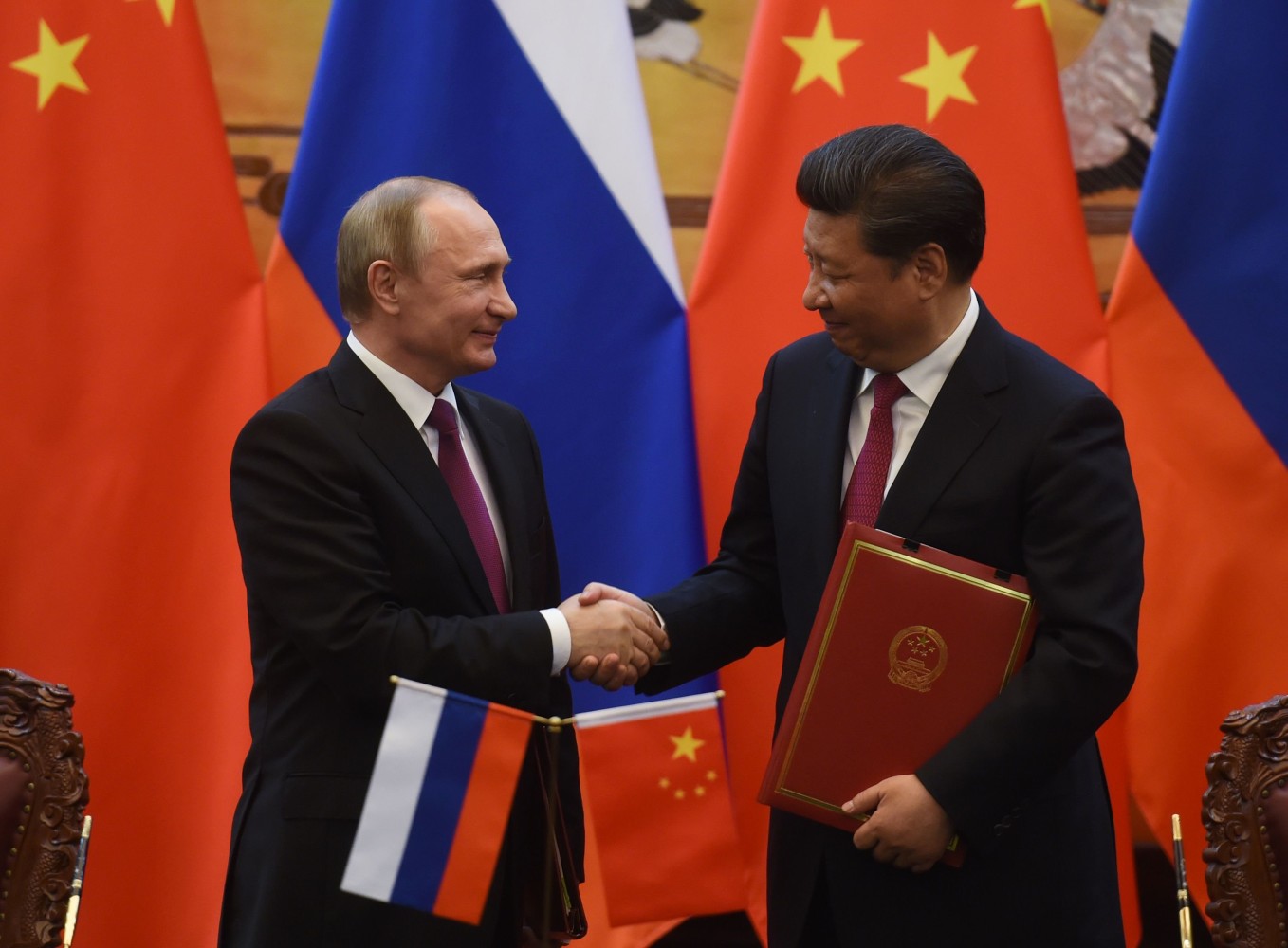
Russian President Vladimir Putin (left) shakes hands with Chinese President Xi Jinping at Beijing's Great Hall of the People on June 25. GREG BAKER / AFP - Getty Images

In 2014, European Union-Russian trade stood at $377 billion, making the bloc Moscow's most important economic relationship. That fell to $235 billion last year. 
Part of the problem for Russia its Far East is an underdeveloped, depopulating region with a mere 6 million inhabitants that is connected to Europe only by one railway line — the Trans-Siberian Railroad.
developed enough, said Vasily Kashin, a China expert with the Higher School of Economics in Moscow. 
He added: "It's a strategic problem, something you can't fix in a hurry." 
Developing its infrastructure and boosting the population will take decades, experts and officials said. 
Then there are the problems of actually doing business with Russia hinted at during the Eastern Economic Forum business conference held in Vladivostok earlier this month. 
Top Chinese businessmen like Tao Ran, the chairman of construction and power company Sirius Holding, mentioned certain "inefficiencies of administration" — a thinly veiled reference to Russia's notoriously inefficient and corrupt bureaucracy. 

Russia's First Deputy Prime Minister Igor Shuvalov conceded that economic integration was moving slowly. 
"Our political relationship is ahead of our economic ties," he said at a speech at conference on Sept. 2. 
The two giants do have long had common political interests. These include curbing global democratization efforts and trying to take control over root internet infrastructure in the world, which would give them greater censorship powers, according to Alexander Gabuev of Carnegie Moscow Center. 
In the U.N. Security Council, the two routinely clash with the other permanent members — Britain, France and the U.S. — although Moscow usually does most of the talking. 
And military cooperation is going strong. The two powers hold regular exercises, and Russia sells China state-of-the-art weaponry such as S-400 missile defense systems and Sukhoi Su-35 warplanes. 
A stubborn and persistent fact underpins both political and economic ties between Moscow and China — both countries' deteriorating relations with the U.S., according to Vasily Kashin, a China expert with the Higher School of Economics in Moscow. 
Aside from the standoff with the West in Ukraine, Moscow and Washington don't see eye-to-eye in Syria where Russia supports President Bashar al-Assad. Russia is also furious about American plans to build a missile defense system near its borders in former Communist countries Romania and Poland. 
China, meanwhile, is locked in a standoff with U.S. allies in the region because of its territorial claims over the much of the South China Sea. Its alleged dumping of cheap products is raising tensions and has led to punitive tariffs on some of its exports.
the standoff between Washington, and Moscow and Beijing could escalate to Cold War levels, Kashin said. 
But in this case, Russia would be relegated to a "vassal" role with China whose economy is around eight times bigger than Russia, he warned. Beijing has the potential to become a far more dangerous opponent for the U.S. than the Soviet Union ever was thanks to its more powerful economy, 
In the long run, the countries' political affinity and geographic proximity make them too well-matched not to integrate, experts say. 
An alliance with China "is the direction most consistent with where Russia has been heading and capable of being sustained," said Princeton University's Rozman.
point out, the United States' own relationship with China took four decades to build, kicked off by Richard Nixon's historic trip to China in 1972 that led to a dramatic rapprochement between the countries. 
"You can't get to this level of cooperation in a couple years," Russia's Deputy Prime Minister Shuvalov told NBC News on the sidelines of the Eastern Economic Forum. "It takes a lot of day-to-day toil." 

Sunday, September 11, 2016

Is an algorithm boss liberating or exploitive for employees ? - Financial Times

In the gig economy, companies such as Uber and Deliveroo manage workers via their phones. But is this liberating or exploitative? 
The small London side street reverberates with the growl of motorbikes and the shriek of horns. A young man yells hoarsely into a megaphone: “They’re gonna be disrupted, yeah! Because your lives are being disrupted, yeah! This is the money you need to live!” Dozens of men in T-shirts and jeans cheer and pump the horns on their motorbikes, scooters and bicycles. Many have pieces of A4 paper taped to their backs that say: “We are people, not Uber’s tools!”
This protest outside the UberEats office in south London on August 26 is one of the first industrial disputes to hit the city’s so-called gig economy. It is a strange clash. These are workers without a workplace, striking against a company that does not employ them. They are managed not by people but by an algorithm that communicates with them via their smartphones. And what they are rebelling against is an app update.
They’re gonna be disrupted, yeah! Because your lives are being disrupted, yeah! This is the money you need to live!
- Chant at UberEats protest
UberEats launched in London in June, promising “the food you want, from the London restaurants you love, delivered at Uber speed”. In a bid to recruit self-employed couriers to ferry food from restaurants to customers, UberEats initially offered to pay £20 an hour. But as customer demand increased, the company began to reduce pay. By August, the couriers were on a piece rate with a fiddly formula: £3.30 a delivery plus £1 a mile, minus a 25 per cent “Uber service fee”, plus a £5 “trip reward”. Then, one day, the couriers woke up to find the app had been updated again. The “trip reward” had been cut to £4 for weekday lunch and weekend dinner times, and to £3 for weekday dinner and weekend lunch times. Outside those periods, it had been cut altogether.
“They tricked us,” roars a man called Manou over the din, hunching over the handlebars of his motorbike. Like many experienced couriers, he left his job with a different delivery company because Uber was offering better pay. Not any more. “They make us feel like they can just use us and destroy us and create new tools,” he says. Imran Siddiqui, one of the leaders of the protest, says he feels bad because he had encouraged other couriers to sign up for UberEats before they changed the pay. “If they don’t resolve this strike it’s going to spread like a fire.”
It’s hard to spread the word when you don’t even know who your colleagues are. But the couriers have an idea. They open their apps as customers and order food to be delivered to them. As UberEats couriers arrive with pizzas at the place their app has sent them, the strikers tell them about the protest and urge them to join in. Algorithmic management, meet algorithmic rebellion.
scale of the gig economy but in the US there are about 800,000 people earning money this way — via online intermediaries such as TaskRabbit, Lyft, Uber and Deliveroo — without being anyone’s employee. The term “algorithmic management” was coined last year by academics at the Carnegie Mellon University Human-Computer Interaction Institute, and it is this innovation, they argue, that makes the gig economy possible. For companies like Uber, which aspires to “make transportation as reliable as running water”, algorithmic management solves a problem: how to instruct, track and evaluate a crowd of casual workers you do not employ, so they deliver a responsive, seamless, standardised service.
Those deploying algorithmic management say it creates new employment opportunities, better and cheaper consumer services, transparency and fairness in parts of the labour market that are characterised by inefficiency, opacity and capricious human bosses. But a summer of wildcat strikes in London’s gig economy shows that some workers are beginning to chafe against the contradictions of being “their own boss” yet tightly managed by the smartphones in their pockets. They might be free to choose when to work but not how to work or, crucially, how much they are paid.
Bad how? Deliveroo’s algorithm monitors couriers closely and sends them personalised monthly “service level assessments” on their average “time to accept orders”, “travel time to restaurant”, “travel time to customer”, “time at customer”, “late orders” and “unassigned orders”. The algorithm compares each courier’s performance to its own estimate of how fast they should have been. An example from one of Kyaw’s assessments: “Your average time to customer was less than our estimate, which means you are meeting this service-level criterion. Your average difference was -3.1 minutes.” Deliveroo confirmed it performs the assessments but said its “time-related requirements” took into account reasonable delays and riders were “never against the clock for an order”.
Drivers for Uber’s ride-hailing app, of which there are about a million around the world, are subject to similar algorithmic control. They choose when to work but once they log on to the app, they only have 10-20 seconds to respond to “trip requests” routed to them by the algorithm. They are not told the customer’s final destination until they have picked them up. If drivers miss three trip requests in a row, they are logged out automatically for two minutes. Uber sends drivers a weekly report including their confirmation rate and average customer rating (out of 5).

Podcast


Using algorithms to monitor performance is associated with companies like Uber and the gig economy, but also harks back to the ‘scientific management’ of Frederick Winslow Taylor a century ago. John Gapper discusses the return of this trend with Sarah O’Connor.
Documents submitted as part of an employment tribunal case brought by the GMB union against Uber in London include an email sent to driver James Farrar in May congratulating him on an average rating above 4.4. “We will continue to monitor your rating every 50 trips and will email you if we see your rating for your past 50 trips falls below 4.6.” Uber will “deactivate” drivers whose ratings drop too low, though it says this is “extremely rare”. The court case documents include one instance, in which Uber sent an email on December 23 2013 to a driver called Ashley Da Gama: “Hi there, we would like to wish you a Merry Xmas and a Happy New Year. We are currently planning for 2014 and would like you to be part of it. However, we do need to see an improvement on your current track record to ensure you are.” Two weeks later, Uber emailed again to say his ratings had not improved enough. His account had been “deactivated . . . as of today”.
 . . . 
Algorithmic management” might sound like the future but it has uncanny echoes from the past. A hundred years ago, a new theory called “scientific management” swept through the factories of America. It was the brainchild of Frederick W Taylor, the son of a well-to-do Philadelphia family who dropped his preparations for Harvard to become an apprentice in a hydraulics factory. He saw a haphazard workplace where men worked as slowly as they could get away with while their bosses paid them as little as possible. Taylor wanted to replace this “rule of thumb” approach with “the establishment of many rules, laws and formulae which replace the judgment of the individual workman”. To that end, he sent managers with stopwatches and notebooks on to the shop floor. They observed, timed and recorded every stage of every job, and determined the most efficient way that each one should be done. “Perhaps the most prominent single element in modern scientific management is the task idea,” Taylor wrote in his 1911 book The Principles of Scientific Management. “This task specifies not only what is to be done but how it is to be done and the exact time allowed for doing it.”
They are treating you like an employee so how can they say it’s self-employment?
- Bhone Kyaw, Deliveroo courier
Bhone Kyaw has been standing around on the street for half an hour when his phone chirrups. It is a balmy Monday evening in London’s wealthy St John’s Wood and orders are finally flowing. Kyaw is one of 20,000 self-employed couriers who work for Deliveroo, a food-delivery company founded in London in 2013 by former investment banker Will Shu. Already in 84 cities across 12 countries, it has just raised $275m from investors to bring its total to almost half a billion dollars, making it one of Europe’s best-funded start-ups.
Kyaw, a boyish-looking 30-year-old, has been working for Deliveroo for about nine months. He works 40-50 hours a week over six days and makes £400-£450 before tax, motorbike insurance and maintenance. In most parts of London, Deliveroo schedules shifts, which couriers agree a week in advance. They must work at least two of Friday, Saturday and Sunday evenings (though Deliveroo says shifts can be moved around when necessary). They are paid £7 an hour plus £1 a delivery, tips and petrol.
Kyaw whips out his phone. The app expects him to respond to new orders within 30 seconds. The screen shows a map and address for the local Carluccio’s, an Italian restaurant chain. A swipe bar says “Accept delivery”. That is the only option. The algorithm will not tell him the delivery address until he has picked up the food from Carluccio’s. Deliveroo couriers are assigned fairly small geographic areas but Kyaw says sometimes the delivery address is way outside his allocated zone. You can only decline an order by phoning the driver support line. “They say, ‘No, you have to do it, you already collected the food.’ If you want to return the food to the restaurant they mark it as a driver refusal — that’s bad.”
so labourers who worked in the yard of the Bethlehem Steel Company. After a series of experiments, he decided that a “first class” shoveller would be most productive if he lifted 21 pounds of weight with every shovel load. He ordered different-sized shovels for each type of material in the yard: a small shovel to hold 21 pounds of ore; a large one to hold 21 pounds of ash. The men went to a pigeonhole each morning where a piece of paper would tell them which tools to select and where to start work. Another piece of paper would tell them how well they had performed the previous day.
“Many of these men were foreigners and unable to read and write but they all knew at a glance the essence of his report, because yellow paper showed the man that he had failed to do his full task the day before, and informed him that he had not earned as much as $1.85 a day, and that none but high-priced men would be allowed to stay permanently with this gang,” Taylor explained.
Taylor advocated his new theory with evangelical zeal. Charles Harrah, one-time owner of the Midvale Steel Company, where Taylor pioneered many of his ideas, once told him: “Do you know what I am going to do when I have made a few more millions? I am going to build the finest insane asylum this world has ever known, and you, Taylor, are going to have there an entire floor.”
Algorithms are providing a degree of control and oversight that even the most hardened Taylorists could never have dreamt of
- Jeremias Prassl, law professor, Oxford university
Nonetheless, scientific management took off, improving productivity in the vast factories of early 20th-century America. It was the logical precursor to Henry Ford’s production lines. And its legacy can be seen in factories, call centres and warehouses today, although new technology has taken the place of Taylor’s instruction cards and stopwatches. Many warehouse workers for companies such as Amazon use handheld devices that give them step-by-step instructions on where to walk and what to pick from the shelves when they get there, all the while measuring their “pick rate” in real time. For Jeremias Prassl, a law professor at Oxford university, the algorithmic management techniques of Uber and Deliveroo are Taylorism 2.0. “Algorithms are providing a degree of control and oversight that even the most hardened Taylorists could never have dreamt of,” he says.
The next frontier for algorithmic management is the traditional service sector, tackling retailers and restaurants. “Taylor’s ideas have been applied very widely in manufacturing . . . but the services industry has always been a black box,” says Serguei Netessine, professor of global technology at Insead business school. “It has been very difficult to figure out: is it employees who are performing well? Or is the employee getting lucky? Now with data we can do this.” So Frederick Taylor is heading to the high street? “Yes — Taylor on steroids.”
Percolata is one of the Silicon Valley companies trying to make this happen. The technology business, which Netessine advises, has about 40 retail chains as clients, including Uniqlo and 7-Eleven. It installs sensors in shops that measure the volume and type of customers flowing in and out, combines that with data on the amount of sales per employee, and calculates what it describes as the “true productivity” of a shop worker: a measure it calls “shopper yield”, or sales divided by traffic.
of employees ranked from lowest to highest by shopper yield. Its algorithm builds profiles on each employee — when do they perform well? When do they perform badly? It learns whether some people do better when paired with certain colleagues, and worse when paired with others. It uses weather, online traffic and other signals to forecast customer footfall in advance. Then it creates a schedule with the optimal mix of workers to maximise sales for every 15-minute slot of the day. Managers press a button and the schedule publishes to employees’ personal smartphones. People with the highest shopper yields are usually given more hours. Some store managers print out the leaderboard and post it in the break room. “It creates this competitive spirit — if I want more hours, I need to step it up a bit,” explains Greg Tanaka, Percolata’s 42-year-old founder.
The company runs “twin study” tests where it takes two very similar stores and only implements the system in one of them. The data so far suggest the algorithm can boost sales by 10-30 per cent, Tanaka says. “What’s ironic is we’re not automating the sales associates’ jobs per se, but we’re automating the manager’s job, and [our algorithm] can actually do it better than them.”
We’re automating the manager’s job and our algorithm can actually do it better than them
- Greg Tanaka, founder of Percolata
Better for the employer? Or better for the workers? Both, argue Tanaka and Netessine. Unlike human store managers, algorithms do not use hours to reward the people they like, or the people they are related to, or the people who look like them. Tanaka is forever fighting battles against the “incredible biases” of managers who want to tweak his algorithm’s carefully calibrated schedules. “The manager comes in and says, ‘Look, my favourite person is not working when I’m working, so I want to muck with the schedule’ and it’s like, ‘Oh my god, just by doing that you lost a few percentage points in sales!’”
Tanaka says his algorithm is also a more reliable boss because it is better at forecasting demand: employees tell the app when they are available to work, then receive their schedules in advance. They are not subject to the chaotic scheduling common in many retail jobs, where employees are sometimes sent home early because the shop is unexpectedly quiet, or told to wait by the phone. Kayley Hignell, head of policy at the UK’s Citizens’ Advice Bureau, a charity, says technology that gave employees more visibility on their rotas and pay would be welcome. Many people have no idea how shambolic some jobs are at the bottom of the labour market, she says: rotas pinned on noticeboards that you have to check on your day off; incomplete payslips that haven’t recorded the right hours. “It’s good to see movement in the direction of utilising tech to help out with those challenges,” she says. But she warns against taking it too far. “Having a good line manager makes people feel more secure . . . you can’t tell a computer that your childcare arrangements are up in the air at the moment.”
Not everyone buys the idea that algorithms will treat people fairly. “You can’t take that seriously,” says Guy Standing, a professor of development studies at the School of Oriental and African Studies, University of London, who writes about precarious work. “The same rule applied to everybody might turn out to be more inequitable than subtle human judgment.”
While Percolata can predict demand and schedule workers up to a month in advance, Tanaka believes that retail jobs will eventually become so flexible in response to fluctuating demand that they become part of the gig economy. Wouldn’t it be better to just pay people more for the time they are actually productive, he asks? “That’s what Uber does; they don’t pay people for sitting in the car when there’s no one in the car.”
 . . . 
Deliveroo has just decided to try the same approach. This summer it started to trial a new system in a few London zones, where couriers are not scheduled in advance but can log in to work whenever they want. The quid pro quo is that they will only be paid a piece rate of £3.75 a delivery. They gain flexibility but shoulder the financial risk — borne previously by the company — that they will wait around unpaid when demand is slow.
That is fine for people such as Anja Bosio, a 21-year-old student, who rides for Deliveroo because she loves to cycle, and usually only at busy times. She used to work as a waitress but she prefers to be out on her own, where the only demands come from the algorithm on her phone. “With waitressing I was always looking over my shoulder; this is a lot less stressful.”
But the new piece-rate system has panicked couriers such as Bhone Kyaw, for whom Deliveroo is a full-time job. He and his partner have a five- and a four-year-old; she works for Deliveroo too but only on weekends when her mother can look after the kids. “There is no way we can survive on £3.75,” he says. He joined a wildcat strike of Deliveroo drivers in August that — with the help of the Independent Workers’ Union of Great Britain — won some concessions from management: guaranteed deliveries per hour during peak times for the period of the trial, and a promise that those who did not want to take part could move to a different zone.
But Kyaw fears that Deliveroo will impose the new system as planned after the trial ends in mid-September. Earlier that morning, he had worked for three hours and received five jobs. Under the old system he would be paid £26; under the new one, £18.75. “They will say, ‘Why are you guys waiting at a time when it’s not busy? But people want to make money because they have a family, and even at the busy time we can’t guarantee how many deliveries we’ll make.”
A few months ago, he was knocked off his motorbike and had to pay for the repairs because his third-party insurance did not cover the incident. He hurt his knees and elbows and couldn’t work for a week. “We need at least a safety net for our earnings to do the bike maintenance, to pay for the insurance, to pay for our rent, our bills.”
Is the problem that couriers like Kyaw are trying to use Deliveroo as a full-time job when it is simply not designed for that purpose? No, he insists. Deliveroo treated him like an employee when it suited them. Like when he came down with flu this March and emailed to say he wouldn’t be able to do his shifts. Deliveroo sent him this email: “Due to your unavailability without any communication I have decided to terminate your services agreement with Deliveroo . . . We will not return your deposit and process your final fees until you have worked your notice period, returned your equipment and shown that you have removed all Deliveroo stickers from your delivery box.”
When Kyaw sent screenshots to prove he had told them he was sick, they reinstated him. Still, he says, “They are treating you like an employee, so how can they say it’s self-employment?” He feels as if Deliveroo has all the power of an employer but none of the responsibility.
Some gig-economy workers and unions are bringing this question to court. They argue that these companies’ algorithms exert so much control over workers that they are really employees in the eyes of the law and thus owed hourly minimum wages, sick pay, holiday pay and the like. This is the kernel of the argument the law firm Leigh Day made on behalf of the GMB union against Uber, which was heard in a London employment tribunal earlier this summer. James Farrar, an Uber driver who was one of the claimants in that case, submitted a long witness statement detailing all the ways in which he said the algorithm controlled him. He was subject to 10-minute log-offs for cancelling too many rides (a process Uber says it has now updated), which presented him with a choice between “a 10-minute sin-bin when I cannot work or earn, and carrying out a trip which is uneconomical or risky for me”. If he worked for himself and Uber’s only function was to connect him with passengers, he argued, he would be able to do “just the journeys I want to do and that I judge are safe”. Uber’s defence was simple: drivers can’t be deemed employees because they have no obligation at all to log on to the app.
The tribunal’s ruling is expected in October. Martin Warren, a partner and head of labour relations at the Eversheds law firm, says the gig economy poses a profound challenge to the way the law defines jobs. Many gig workers simply do not fit neatly under an employee or a self-employed label. “Is it going to lead to a redefinition of the employment/self-employment divide with a broader test for employment? That is the question to pose.”
Policymakers, meanwhile, are flummoxed. Robert Rubin, former US Treasury secretary, summed up their dilemma at a recent Hamilton Project think-tank discussion on the gig economy. “The question is how to protect workers while at the same time garnering and reaping the benefits of change and innovation.”
Gig-economy companies provide undoubtedly popular services to consumers, and many workers clearly value the flexibility to work when they want. Make us treat workers as traditional employees, the companies say, and all that will go away.
An Uber representative told the FT that both “private hire drivers and couriers partnering with Uber do so with complete flexibility and are able to choose when and where they log in. Uber does not set shifts or allocate zones for its couriers or partner-drivers to operate in. Over 30,000 people have partnered with Uber in London so they can be their own bosses and make money on their own terms.” He said UberEats had offered pay incentives in the early days while it built demand for the service, and was now reducing them because couriers were making more deliveries, so were earning more at peak times.
A Deliveroo official said: “All of our riders work with us flexibly, often around other commitments, such as studying, family or additional work commitments.” Some 85 per cent of couriers have told Deliveroo they use it for “a supplementary income, or short-term flexible work”. She also said that previous trials of the piece-rate system found that couriers’ earnings were up to 2.1 times higher at the busiest times, with “our most efficient riders” making £15-£18 an hour. She added that safety was Deliveroo’s “top priority”.
Yet for critics such as Guy Standing, one man’s flexibility is another man’s insecurity. The gig economy is fuelling a “precariat” class of workers denied the protections of traditional jobs, he says. Algorithms provide “fantastic opportunities for rapacious exploitation” of people who are already at the bottom of the labour market. “They can monitor and make sure they only pay for the time they really want to pay for, and yet have people available at all times, waiting on call.”
We were having these same arguments 100 years ago. Taylor’s “scientific management” triggered a swift backlash from unions and workers, resulting in a special congressional investigation in 1911. Trade unionists, factory workers and Taylor himself were summoned to Congress to testify about this strange new system.
Algorithms provide ‘fantastic opportunities for rapacious exploitation’ of people who are already at the bottom of the labour market
- Guy Standing, professor of development studies, SOAS
James O’Connell, the president of the International Association of Machinists, used his appearance to condemn the “lead-pencil faddists” who were deskilling work and dehumanising workers. Edward Vreeland, a Republican congressman, asked him whether piecework was not the fairest way to pay. “No,” he snapped. “Under no circumstances. The boss sets the price, the speeder sets the pace, the strong, stout, energetic young man sets the standard of life for his older brothers. That is piecework. The organisation of men has been driven out in every way, and the men are helpless.”
He declared to the assembled congressmen: “The labouring men of this country will not permit the Taylor system to be introduced in the factories in this country.”
Taylor could not have predicted the rise and fall of America’s trade unions over the rest of that century. But, like many of today’s gig-economy companies, he was quietly confident that his ideas would win out in the end. Like Uber and Deliveroo, he had faith in the power of his system to provide consumers with cheaper and better stuff, and believed that would ultimately overwhelm all objections. “At first glance we see only two parties to the transaction, the workmen and their employers,” he wrote in his book. “We overlook the third great party, the whole people — the consumers who buy the product of the first two.”
“In the end,” he predicted, “the people . . . will force the new order of things on both employer and employee.”
Sarah O’Connor is the FT’s employment correspondent
Photographs: Fred MacGregor; Mark Kerrison / Alamy Stock Photo; Press Association; Everett Collection Historical / Alamy; Carlos ChavarrĂ­a